Natilus and Palantir Announce Strategic Partnership to Accelerate Production of Sustainable Commercial Aircraft
Palantir’s advanced AI-based operating system will supercharge Natilus’s engineering, design and manufacturing as it rapidly scales U.S. production capabilities for blended-wing aircraft
SAN DIEGO, April 30, 2025 /PRNewswire/ — Natilus, an aerospace manufacturer of blended-wing-body aircraft, today announced a strategic partnership with Palantir Technologies Inc. to advance the production of sustainable aircraft in the U.S. Through the collaboration, Natilus and Palantir are deploying an AI-based operating system to accelerate the development of innovative approaches to design, engineering and manufacturing and streamline Natilus’s operations and strengthen its supply chain.
In an era of critically constrained access to aircraft components, market demand for cargo and passenger aircraft is outpacing domestic manufacturing capabilities. With the aviation industry challenged to operate more sustainably, cargo and passenger airlines are eager to pursue more technologically advanced approaches to deliver elevated yet economical fleet operations.
To address the market demand, Natilus is developing a family of blended-wing-body aircraft for commercial operations. With an advanced carbon fiber airframe design, Natilus’s family of aircraft includes a regional blended-wing-body freighter KONA, and a 200-passenger aircraft, the HORIZON, which both offer major advantages in fuel consumption, carbon emissions, and payload capacity.
“The U.S. desperately needs a boost in aircraft manufacturing, and Natilus is operating at the forefront of sustainable aircraft manufacturing,” said Aleksey Matyushev, Co-Founder and CEO of Natilus. “We made a commitment to build the first manufacturing facility for the world’s most efficient commercial aircraft here in the U.S. Our success hinges on accelerating our production capabilities, and leveraging Palantir’s AI-driven platform will allow us to transform our manufacturing operations to run more efficiently and meet customer demand for the cargo and passenger markets.”
Natilus is deploying Palantir Warp Speed for its operations, providing AI-driven data, analytics and modeling to drive real-time decision making. Through the collaboration, Natilus will initially focus on increasing supply chain resiliency and manufacturing efficiency, and further down the line, offering its cargo and passenger customers key insights to enable predictive maintenance, disruption recovery and capture real-time aircraft performance data for product optimization.
“Natilus is delivering the future of sustainable aircraft, and we are extremely proud of deploying software that supports the sustained competitive advantage of their blended-wing-body aircraft,” said Emily Nguyen, Head of Industrials at Palantir. “By providing the foundation on which Natilus will integrate all aspects of their aircraft design, engineering and manufacturing, Palantir is committed to helping Natilus build faster and strengthen the U.S.’s position in the global aviation landscape.”
About Natilus Natilus is a San Diego-based company developing a family of hyper-efficient blended-wing-body (BWB) aircraft designed to transport people and cargo more sustainably and efficiently than ever before. Natilus’s BWB aircraft unlock improved aviation economics by reducing fuel consumption by 30% while increasing payload capability by 40%. Founded in 2016, the Natilus team is comprised of innovators from General Atomics, Northrop Grumman, Skunkworks, SpaceX, and Piper Aircraft. Learn more at natilus.co.
San Diego-based aerospace manufacturer Natilus searching for new building site
Natilus, a venture-backed aerospace company based in San Diego, has announced plans to search for a new site to build blended-wing-body passenger and freighter planes.
The facility will be used to manufacture and produce their regional blended-wing-body freighter Kona, the first of its kind in the world. The facility will also be expanded with a larger production footprint for its 200-passenger Horizon aircraft.
The company’s futuristic-looking planes, aimed at decarbonizing aviation, feature conventionally configured landing gear and a slender fuselage that allow compatibility with existing gate operations and infrastructure at major airports, Natilus says.
The aircraft also has a striking appearance.
“It looks very much like a flying triangle,” said Nolan Giblin, head of Natilus business development.
That shape allows for far less fuel consumption, he said. “In a traditional aircraft, 90 percent of the lift comes from the wing and the rest from the fuselage… with blended wing aircraft it’s roughly 50-50.”
That can reduce fuel burns and emission by roughly 50 percent, according to the company.
Aviation supply chains anticipate strain under tariffs announced this week by the Trump administration this week, which could delay deliveries of cargo and passenger aircraft to American airlines.
However, by establishing its first manufacturing facility in the United States, Natilus says it will be able to weather potential trade restrictions and supply chain disruptions.
Get neighborhood news in your inbox. It’s free and enlightening.
Natilus’s aircraft will be made with carbon fiber airframes, which offer major advantages in fuel consumption, carbon emissions, and payload capacity — and which will be less affected by trade restrictions, unlike materials such as steel and aluminum.
The company has no plans to leave San Diego, said Giblin, adding that they wish to grow, not leave.
“Even though we announced our intention to expand our footprint in the U.S., our desire is to maintain headquarters and engineering here in San Diego,” he said.
Aircraft Manufacturer Natilus Begins Search for New Home to Build World’s Most Efficient Commercial Aircraft
Key Points:
Natilus has received strong commercial demand for its blended-wing-body aircraft with more than 570 pre-orders of aircraft across the product line
Phase I begins with a U.S.-based 250,000 sq ft manufacturing site to build 60 KONA regional cargo aircraft per year and employ more than 300 workers
Phase II will commence with a global search for a 2.5 million sq ft facility employing 3,000 people to manufacture a 200-passenger aircraft HORIZON
SAN DIEGO, March 25, 2025 /PRNewswire/ — Natilus, an aerospace manufacturer of blended-wing-body aircraft, has begun the process of selecting the site of its first U.S. manufacturing facility. The large-scale facility will produce Natilus’s regional blended-wing-body freighter KONA, the first of its kind in the world. A strong signal of the momentum in commercializing blended-wing-body aircraft, the facility will be expanded with a larger production footprint for its 200-passenger aircraft, HORIZON.
New tariffs on critical materials are expected to exacerbate aviation supply chain challenges and further delay deliveries of cargo and passenger aircraft to U.S. airlines. By establishing its first manufacturing facility for blended-wing-body aircraft in the U.S., Natilus is well-positioned to mitigate the impact of potential trade restrictions and supply chain disruptions.
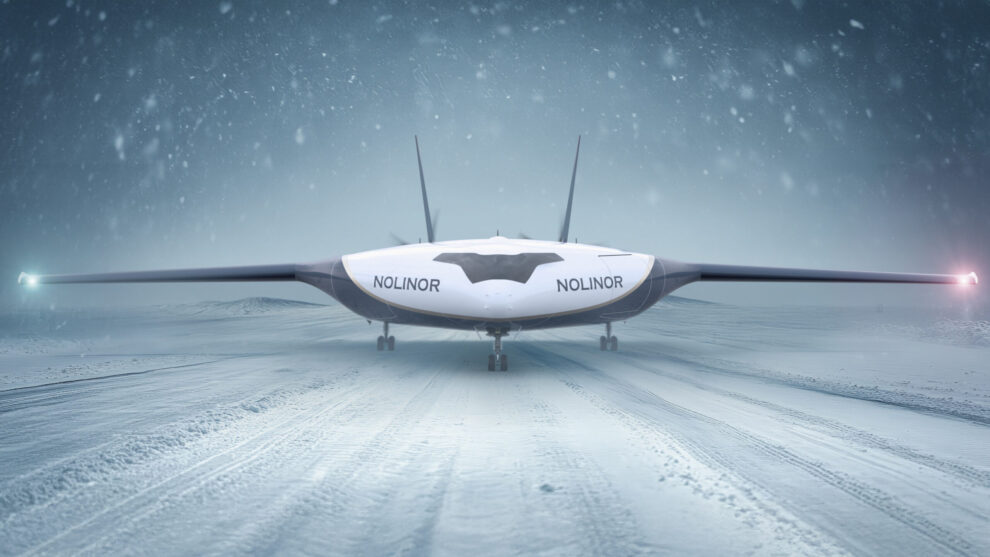
Natilus’s family of blended-wing-body aircraft will be made with carbon fiber airframes and offer major advantages in fuel consumption, carbon emissions and payload capacity. The latest customer that has reserved multiple production slots of KONA for its operations in northern Canada is Nolinor Aviation. Capable of navigating rugged terrain and extreme weather conditions, KONA provides game-changing improvements in operational costs, with a 30% reduction in fuel consumption, 40% more volumetric capacity and a 50% decrease in carbon emissions – all while using existing engine technology.
“By manufacturing the world’s first commercial blended-wing-body aircraft domestically, we hope to strengthen the U.S.’s position in the aviation industry,” said Nolan Giblin, Head of Business Development at Natilus. “This is the first of several moves Natilus has planned in its larger roadmap to supply major airlines with a more sustainable and cost-effective aircraft.”
Once operational, the 250,000-square-foot facility will have the production capacity for 60 KONA aircraft annually. As part of the build, Natilus will hire 300 full-time skilled employees across manufacturing, aerospace, propulsion and test engineering, including production and quality roles, test pilots and machine technicians.
For Phase I, Natilus is prioritizing geographic regions in the U.S. with strong state and local incentive programs and facilities with adequate runway length, airspace clearance for testing, training and selloff facilities and proximity to suppliers and transportation. Natilus’s search for its first manufacturing location builds upon the recent trend of aerospace technology companies –such as Boom Supersonic, Joby Aviation and Archer Aviation – that have successfully found suitable hubs in the U.S. with access to skilled labor. With interest from major real estate development partners, Natilus expects to announce further details in the coming months.
Natilus is currently engaged with many prospective states and countries including the U.S., UAE, India and Saudi Arabia about potential sites for the second facility. In the second phase, Natilus plans to develop a 2.5 million square foot facility to accommodate production of the HORIZON passenger aircraft, which is classed in the same narrowbody segment as the Boeing 737s and Airbus A320s in use today. Anticipated to be one of the largest manufacturing sites of its kind, the facility is expected to employ around 3,000 skilled workers once it comes online in the early 2030s.
“We believe that more competition breeds better planes,” said Aleksey Matyushev, Co-Founder and CEO of Natilus. “As trade routes become increasingly complex, we are positioned to manufacture a carbon fiber aircraft that will meet the needs of our customers, who are all searching for the most efficient way to transport cargo and people.”
About Natilus Natilus is a San Diego-based company developing a family of hyper-efficient blended-wing-body (BWB) aircraft designed to transport people and cargo more sustainably and efficiently than ever before. Natilus’s BWB aircraft unlock improved aviation economics by reducing fuel consumption by 30% while increasing payload capability by 40%. Founded in 2016, the Natilus team is comprised of innovators from General Atomics, Northrop Grumman, Skunkworks, SpaceX, and Piper Aircraft. Learn more at natilus.co.
Canadian Airline Nolinor Purchases Production Slots for Natilus KONA Cargo Aircraft
Regional freighter KONA will transport equipment and supplies to remote locations with minimal infrastructure
SAN DIEGO and MONTREAL, Feb. 4, 2025 /PRNewswire/ —Nolinor Aviation, Canada’s largest commercial charter airline, announced the purchase of multiple aircraft production slots from Natilus, a U.S. aerospace manufacturer developing a family of hyper-efficient blended-wing-body (BWB) aircraft. As part of the agreement, Nolinor has purchased production slots for Natilus’s regional freight aircraft, the KONA. The addition of KONA to its existing fleet will support Nolinor’s goal of expanding its services to remote operations in the Northwest Territories and Nunavut while reducing emissions in these ecologically sensitive areas.
As global electrification drives substantial growth in mining activities across northern Canada, Nolinor is experiencing an increase in flight demand for the transportation of workers, equipment and supplies in its key service regions. Operating amid limited road infrastructure and challenging weather conditions, Nolinor serves as a lifeline to remote regions in rural Canada, transporting essentials and equipment during the summer months.
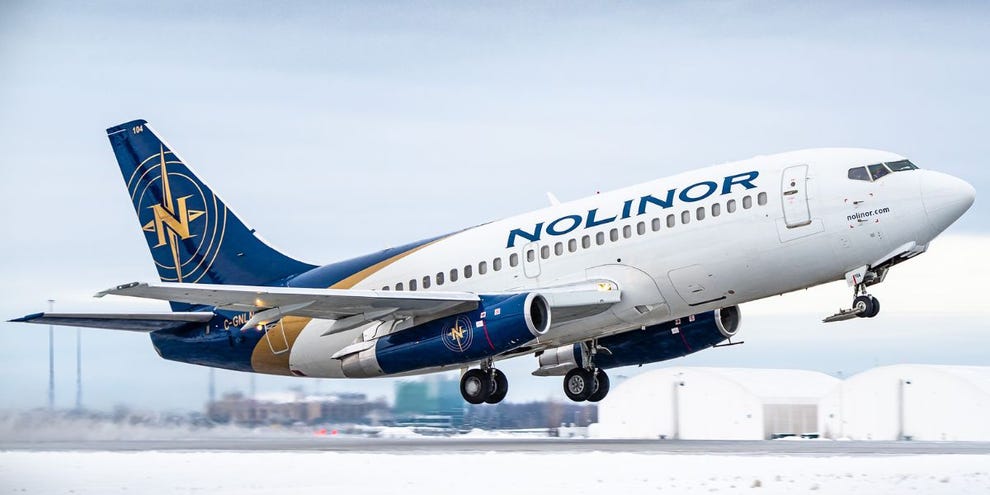
Nolinor is the world’s largest operator of the B737-200 aircraft, which are equipped to land on dirt, gravel, or ice runways. The B737-200 allows for greater cargo capacity and requires fewer trips to transport essential cargo – making it particularly suited for deliveries to the northern regions. To maintain its competitive edge in the market, Nolinor is investing in fleet expansion and looking for new airframe designs – such as the blended-wing body – to meet its future needs.
“This partnership marks a pivotal step in our commitment to innovation and operational excellence,” said Marco Prud’Homme, President of Nolinor Aviation. “During our visit to Natilus’s head office in San Diego last fall, we were impressed by their groundbreaking approach to aircraft design and their dedication to addressing the unique challenges of the cargo industry. The KONA’s gravel runway capability is a perfect match for our operations, and we are eager to leverage its potential to better serve our customers across Canada and beyond.”
The first to commercialize the blended-wing-body design for commercial freight operations, Natilus is developing a family of sustainable blended-wing-body (BWB) aircraft designed to unlock improved aviation economics by reducing fuel consumption by 30% while increasing payload capability by 40%. Like the B737-200, Natilus’s regional cargo aircraft, the KONA, can take off and land in challenging environments, including unpaved, shorter gravel runways typically found in northern Canada. The KONA also offers 50% lower operating costs when compared to similarly sized tube-and-wing aircraft.
“For isolated communities in northern Canada, air freight serves as a lifeline to access essential goods and services and enables connectivity to other territories,” said Aleksey Matyushev, CEO and Co-Founder of Natilus. “As Nolinor continues to evolve its specialized air freight service for passenger and cargo transit, Natilus is committed to supporting their efforts to improve logistics efficiency and reduce the carbon emissions of their fleet operations.”
Natilus is expected to begin production of KONA before the end of the decade, followed by its passenger aircraft, the Horizon, in the early 2030s.
About Nolinor Aviation Founded in 1992, Nolinor Aviation is a leading provider of specialized commercial charter flights. The airline operates across Canada, the United States, and various international destinations. Nolinor Aviation is recognized for its commitment to safety in both its equipment and services. As a private company, Nolinor Aviation (IATA code N5) is wholly owned by the Prud’homme family trust. The company has established a strong presence in the charter flight sector, offering tailored services to meet diverse transportation needs. For additional information about Nolinor Aviation and its services, please visit www.nolinor.com. Updates and news can also be found by following @nolinor_aviation on Instagram.
About Natilus Natilus is a San Diego-based company developing a family of hyper-efficient blended-wing-body (BWB) aircraft designed to transport people and cargo more sustainably and efficiently than ever before. Natilus’s BWB aircraft unlocks improved aviation economics by reducing fuel consumption by 30% while increasing payload capability by 40%. Founded in 2016, the Natilus team is comprised of innovators from General Atomics, Northrop Grumman, Skunkworks, SpaceX and Piper Aircraft. Learn more at natilus.co.
Why a cargo airline is eyeing a radical new aircraft design for its future planes
A cargo airline is eyeing a revolutionary new aircraft design to handle rough flying historically handled by its specialized Boeing 737-200 fleet. Natilus
A Canadian airline plans to expand its fleet with a futuristic “blended-wing body” aircraft.
The design would be a first in commercial aviation.
The manufacturer plans to also build a 200-person airliner to challenge Boeing and Airbus.
Canadian charter airline Nolinor Aviation has agreed to buy an all-new aircraft type known as a “blended-wing body” as it expands beyond its all-Boeing fleet.
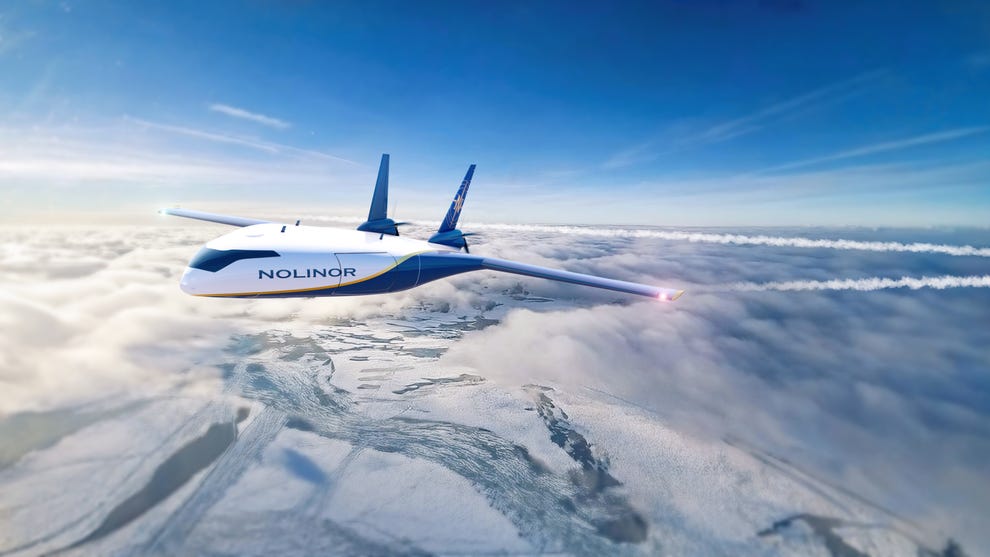
The futuristic cargo plane “Kona” is being developed by California-based startup Natilus. Its design combines the fuselage and wings into one section that the company says can reduce fuel consumption by 30%.
Smaller than some other cargo-specific planes in service today, Kona would complement Nolinor’s fleet of larger Boeing 737-200 freighters when it enters service after 2028, all of which are at least 40 years old, President Marco Prud’Homme told Business Insider.
“It’ll be like opening a new horizon for us, and we can fly to more places that we couldn’t in the past,” Prud’Homme said. “For example, the 737-200 would be too much capacity for some communities, but a weekly flight with Kona would be perfect.”
He pointed to its 50% lower operating costs compared to similar plane types and its ability to reach more remote places, land on unpaved terrain, and carry more bulky cargo than competing planes.
Kona can handle rough terrain essential to rural flying Nolinor’s main business is flying for mining companies in Northern Canada, including carrying passengers and cargo to various sites. Prud’Homme said the airline flies five or six times a day up north.
There is little infrastructure in these areas, meaning most of the runways are gravel, grass, ice, or dirt. Nolinor has historically relied on its aging 737-200 aircraft to reach these places, thanks to a special kit that can be equipped on the jetliner.
Nolinor has the largest fleet of Boeing 737-200s. The planes’ nose gear and engines are specially modified to handle unpaved runway debris. Nolinor Aviation
Newer 737 models do not have this ability — greatly limiting Nolinor’s fleet options. However, Natilus’ Kona aircraft is being designed to tackle the job.
Natilus CEO Aleksey Matyushev told BI that Kona’s field performance is focused on gravel, dirt, and grass, but it would likely not be ice-capable.
He added that the carbon-fiber fuselage would have a special coating to protect it from gravel or other terrain being kicked up, and the propellers would be optimally located away from much debris.
While competing propeller aircraft, like the De Havilland Canada Otter or the Pilatus PC-12, can also land on unpaved runways, Prud’Homme said Kona’s engine placement was a major selling point.
Kona’s engines are mounted to the back of the aircraft instead of on the nose or sides like those of competing planes. Natilus
“It’s a very costly operation,” he said. “When we saw their design has the engines mounted at the back of the aircraft, and basically the aircraft becomes the protection for the engines, we saw that this was a great potential for us.”
Less cargo but more market opportunities Kona would carry about 8,500 pounds of cargo — far less than the nearly 30,000-pound carrying capability of Nolinor’s 737-200.
However, Prud’Homme said the smaller Kona’s 900-nautical-mile range and nearly 1,200 cubic feet of cargo space would open new market opportunities and is overall better performing than competing options.
He explained that one of the mining missions Nolinor is eyeing would require 5,000 to 6,000 pounds of cargo, which Kona could carry and deliver within two hours.
Kona’s fuel savings also mean it won’t need to refuel after one leg, saving time and money. Its side-loading door could create efficiency in loading and unloading.
Prud’Homme said the aircraft would largely carry perishable goods, but it could also carry equipment and appliances.
He added that the diamond-shaped Kona could also uniquely accommodate awkward-sized items that traditional tube-and-wing planes can’t.
“Sometimes the problem we have up north is that we bulk out on volume before payload because some of those items are not very heavy, but they take a lot of space,” Prud’Homme said. “Kona has a lot of volume capacity, so that’s interesting for us.”
The competing ATR 72-600 freighter, for example, can carry more than twice the weight of Kona but has 150 fewer cubic feet of volume. The Cessna Sky Courier falls short of Kona in both metrics.
Natilus wants to eventually compete with Boeing and Airbus Beyond Kona, Natilus is also looking to create a 200-passenger BWB airliner named Horizon to challenge Boeing and Airbus.
Matyushev previously told BI that the plane isn’t expected to hit the market until the early 2030s. But it’s expected to fill a perceived market gap that Natilus believes Boeing and Airbus cannot handle.
Prud’Homme said Horizon, with its 50% better fuel efficiency than traditional jetliners, could eventually replace Nolinor’s 737 aircraft.
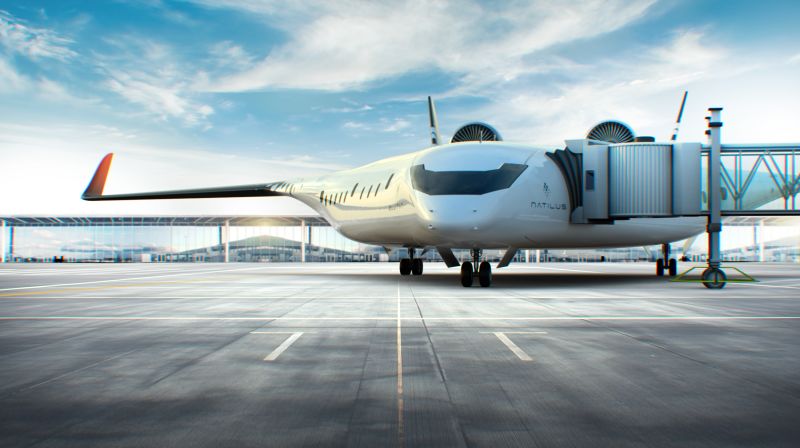
Natilus thinks its blended-wing Horizon jet will be the future of commercial aviation. Natilus
Matyushev said Natilus is in talks with various companies for both of its planned planes.
The company has already secured purchase agreements for Kona from the US cargo airline Ameriflight, a partner of FedEx, DHL, and UPS — and it expects to gain further cargo business in remote places in Alaska, Africa, and India.
“The only way to really connect these mines or remote communities is through air travel,” Matyushev said. “Of course, freight is a huge part of that whole equation.”
Natilus Debuts its New Passenger Aircraft “Horizon” to Decarbonize Global Commercial Aviation
Key Points:
With its dramatic decrease in carbon emissions, blended-wing-body emerges as the fleet design of choice for global commercial carriers
Natilus’s first passenger aircraft emits 50% less emissions and burns 30% less fuel than traditional tube-and-wing aircraft
Horizon is capable of transporting 200 passengers from Los Angeles to Boston or New York to London
Natilus will be the first to commercialize the blended-wing-body design for commercial aviation
SAN DIEGO, Oct. 23, 2024 /PRNewswire/ — Natilus, an aerospace manufacturer developing a family of hyper-efficient blended-wing-body aircraft (BWB) to decarbonize commercial aviation, today debuts Horizon, the company’s first passenger aircraft. The Horizon utilizes an innovative blended-wing-body design capable of transporting 200 passengers with cargo along intercontinental routes such as Los Angeles to Boston or transatlantic routes from New York to London. The Horizon utilizes an innovative blended-wing-body design capable of transporting 200 passengers with cargo along intercontinental routes such as Los Angeles to Boston or transatlantic routes from New York to London.
Over the next two decades, market demand for passenger and freight aircraft will significantly outpace aircraft manufacturing capabilities. As global carriers aggressively pursue net zero targets, Natilus’ BWB design offers exceptional aerodynamic efficiency and significantly more interior volume while burning 30% less fuel than the traditional tube-and-wing aircraft used in commercial aviation today.
“The commercial aviation industry is looking for real solutions to become more sustainable, more efficient, and more profitable. With the Horizon, we’re introducing improved aviation economics that benefit the industry while helping safeguard our planet for future generations,” said Aleksey Matyushev, CEO and co-founder of Natilus.
Delivering 40% greater volume in each aircraft compared to tube-and-wing configurations, the Horizon enables commercial airlines to deliver an improved flight experience with customizable cabin and seating layouts for up to 200 passengers. Offering significantly quieter operations than today’s aircraft, the Horizon is designed to be compatible with existing gate operations and airport infrastructure at major airports
Fitting the same payload class as the Boeing 737 and Airbus 320 narrowbody aircraft, the Horizon is forecasted to begin customer delivery in the early 2030s, timing that aligns with fleet purchasing decisions by commercial carriers to meet the airline industry’s 2050 net-zero goals.
“Commercial aviation is on the brink of a transformative shift toward both greater efficiency and increased sustainability,” stated Dennis Muilenburg, Chairman and CEO of New Vista Capital and former CEO of the Boeing Company. “The Natilus Horizon aircraft is poised to revolutionize fleet operations, enabling airlines to maximize capacity while delivering an elevated passenger experience.”
The Horizon marks the second product introduced by Natilus following its regional cargo aircraft Kona, which is designed to bring the benefits of BWB technology to the commercial cargo industry. Kona remains on track for first customer delivery in the late 2020s.
About Natilus Natilus is a San Diego-based company developing a family of hyper-efficient blended-wing-body (BWB) aircraft designed to transport people and cargo more sustainably and efficiently than ever before. Natilus’s BWB aircraft unlock improved aviation economics by reducing fuel consumption by 30% while increasing payload capability by 40%. Founded in 2016, the Natilus team is comprised of innovators from General Atomics, Northrop Gruman, Skunkworks, SpaceX and Piper Aircraft. Learn more at natilus.co.
Natilus and MONTE Announce Partnership to Offer Leasing of Kona Regional Blended-Wing-Body Aircraft
SAN DIEGO (April 11, 2024) – Natilus, a U.S. aerospace company developing next-generation blended-wing-body aircraft, has announced a strategic partnership with MONTE Aircraft Leasing (MONTE), the pioneering zero-emissions regional turboprop aircraft lessor. MONTE will provide leasing and financing options for the Kona aircraft to Natilus customers, making the path towards sustainable aviation more attainable.
This collaboration between Natilus and MONTE will accelerate the adoption of eco-friendly air transportation solutions while meeting the increasing demand for efficient cargo transport services. Natilus’ commitment to innovation and sustainability is evident in its development of next-generation blended-wing-body aircraft, designed for optimal fuel efficiency and reduced environmental impact.
MONTE’s decision to offer leasing and financing solutions for the Kona aircraft underscores its dedication to driving positive change within the aviation sector. By incorporating the Kona aircraft into its leasing portfolio, MONTE empowers businesses to embrace sustainable practices while achieving their logistical goals.
“We are thrilled to partner with MONTE to make our Kona aircraft more accessible to customers,” said Aleksey Matyushev, CEO and co-founder of Natilus. “This collaboration represents a significant step forward in our mission to revolutionize the cargo transport industry with innovative, environmentally friendly solutions.”
The Kona aircraft, developed by Natilus, will be the first commercially available aircraft from the company, leveraging the superior blended-wing-body design and providing more than double the cargo volume compared to traditional airplanes of similar size. The Natilus Kona is significantly more efficient than tube-and-wing aircraft, enabling customers to reduce their operating costs by more than half. The aircraft is also ideally suited for hydrogen-electric propulsion, providing a clear path to a zero-emission future in aviation.
“The Kona is a unique aircraft, which has been developed specifically to optimize air cargo operations,” said Timothy Eyre, Chief Operating Officer of MONTE. “We are delighted to partner with the Natilus team to support the Kona aircraft and the regional cargo market. The opportunity to integrate hydrogen electric propulsion systems into the aircraft is strongly aligned with our strategy to decarbonize regional aviation”.
Natilus and MONTE are poised to transform the air cargo industry through their shared vision of sustainability and innovation. By offering leasing and financing solutions for the Kona aircraft, they are paving the way for a greener, more efficient future of air transportation.
For more information about Natilus and the Kona aircraft, please visit https://natilus.co/
To learn more about MONTE and its commitment to sustainable aviation solutions, please visit https://www.montecleantech.com/
The Sound of Progress: How Natilus Blended-Wing-Body Aircraft Bring Quieter Flights to Our Communities
Aviation technology is a modern marvel, but the traditional tube-and-wing aircraft design has remained virtually unchanged for decades. There is now an increasing demand for rapid improvements with the industry being pushed to achieve more efficiency and less disruption to the environment. This of course means lowering aviation emissions, and it also means minimizing the noise generated from aircraft that fly in and out of our communities. Natilus blended-wing-body aircraft are not only more efficient, but they are significantly quieter than conventional airplanes thanks to the innovative design.
The noise generated by traditional tube-and-wing aircraft during takeoff and landing can be disruptive, affecting the well-being of individuals living near airports. According to the UK Civil Aviation Authority (CAA), aircraft noise can affect human health and wellbeing in a variety of ways, including sleep disturbances, increased stress levels, and cardiovascular problems. Recognizing these concerns, regulatory bodies worldwide have implemented noise mitigation measures, including curfews and noise abatement procedures, to minimize the impact on communities. For example, the San Diego International Airport, located close to our office, prohibits departures from 11:30 p.m. until 6:30 a.m. Curfew violators are subject to steep fines, not to mention frustrated residents.
Natilus blended-wing-body aircraft have several key advantages over traditional tube-and-wing airplanes. Notably, they are more aerodynamically efficient, reducing drag which thereby decreases fuel consumption. Another advantage of this aerodynamic efficiency is that it allows for smaller engines without compromising performance. The smaller engines not only generate less noise, but they also weigh less, which makes the overall weight of the plane even lighter and more efficient – a compounding effect.
Furthermore, the design of Natilus aircraft enables top-mounted engines. With the body of the aircraft subduing much of the noise generated by the engines mounted above, a drastic reduction of sound from the aircraft to those below is achieved. Altogether, there is a reduction in noise of about 40% compared to traditional tube-and-wing aircraft.
The benefits of quieter aviation extend beyond noise reduction alone. Research suggests that reducing aircraft noise can lead to improvements in community health, quality of life, and property values. Moreover, quieter flights enable airports to operate more efficiently, especially during nighttime hours when noise restrictions are most stringent. By facilitating expanded flight operations, quieter aircraft support economic growth and global connectivity while minimizing disturbances to nearby residents.
In addition to its social and economic benefits, quieter aviation aligns with broader environmental objectives. Natilus’ commitment to noise reduction contributes to a more sustainable aviation ecosystem by reducing overall noise pollution levels. This aligns with the International Civil Aviation Organization’s (ICAO) efforts to mitigate the environmental impact of aviation, including noise emissions.
As aviation continues to evolve, the quest for quieter skies remains paramount. By combining technological innovation with a commitment to community well-being and environmental stewardship, Natilus is shaping the future of aviation—one quieter flight at a time.
Introducing the Future of Remote Aviation in Partnership with Ameriflight: Natilus POD
The air cargo industry is vital to our contemporary way of life, but it hasn’t experienced a step change in modernization over the past several decades. Similar to general aviation, technological improvements in the commercial cargo world happen incrementally and prudently. However, the industry has reached a watershed moment with the culmination of pilot shortages, skyrocketing ecommerce demand, and supply chain inefficiencies – as well as significant advancements in relevant technologies.
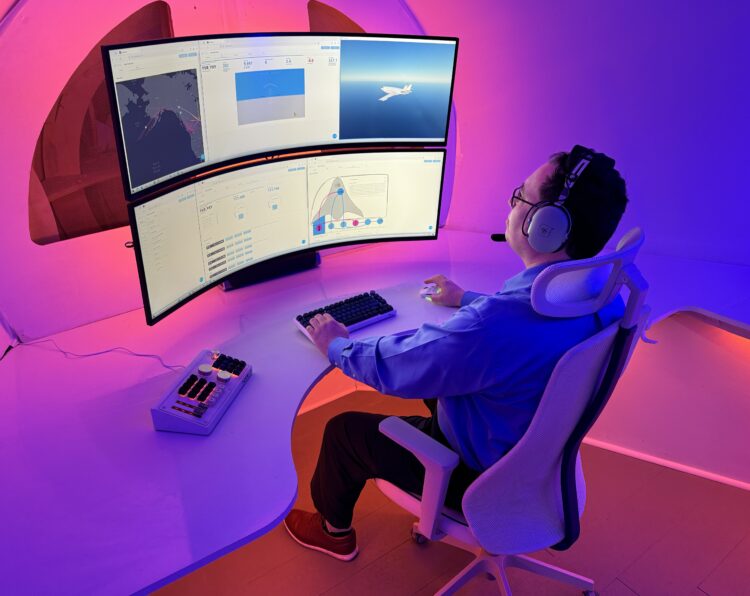
Today, we are thrilled to introduce Natilus Pilot Operations Desk (POD): a cutting-edge ground control station designed to seamlessly integrate with the Natilus family of next-generation cargo aircraft. Our partnership with Ameriflight, leader in regional air cargo and aviation transportation, will ensure we are directly addressing major challenges the cargo industry is currently facing while building a roadmap for the evolution of the product.
With Natilus POD, we set out to push the boundaries of how air cargo operators aviate, navigate, and communicate, while providing functional benefits that were previously unattainable. The POD serves as a conduit that enables remote pilots to interface with the skies as seamlessly as if they were in the cockpit. This ease of operation will translate into improved training and reduced operational costs for customers. It also means happier and healthier pilots that can work from the comfort of an operations center near their homes. Eventually, one operator will be able to monitor up to three Natilus aircraft from the POD, enabling global reach with local control, all built to safety measures high above today’s standards. This provides the added benefit of more easily scaling business operations to meet growing scheduled and on-demand needs.
The POD is a major milestone on our path towards integrating the Natilus fleet into our customers’ existing operations. We’re proud to be partnered with the Ameriflight team who is playing a crucial role in shaping the future of Natilus POD. Their hands-on testing and feedback of our developments are invaluable in refining the system, ensuring it meets the rigorous demands of real-world cargo operations. Ameriflight’s involvement brings critical insights into the day-to-day challenges and opportunities in air cargo, guiding the evolution of the POD to better serve the industry.
“Ameriflight is proud to partner with Natilus on this state-of-the-art aircraft and the technology that’s being created alongside it. We’re impressed with Natilus’ continued commitment and recognition of the air cargo industry need, directly demonstrated by their hands-on and collaborative approach to receiving feedback on needed capabilities,” says Ameriflight CEO Alan Rusinowitz. “We look forward to our continued partnership and ultimately to implementing the Natilus aircraft into our operation to ensure the success of additional business growth opportunities on our horizon.”
Ameriflight team members with Natilus CEO Aleksey Matyushev
Natilus is leveraging satellite and airborne networks aided with cloud infrastructure to ensure communications that are robust, redundant, timely, and compliant. With our network partners, we are demonstrating seamless ATC communications and C2 links for all phases of flight. In a sophisticated airspace and with near-airport infrastructure, aircraft operators can interface with ATC through traditional voice comms or data comms in lock step with the FAA’s broader NextGen initiative. This includes integration with existing technologies like Controller Pilot Data Link Communications (CPDLC), development of ground-to-ground digital voice solutions, and more. In a remote environment, the vehicle is an airborne relay via a Satcom network to enable safe, cooperative communications and vehicle deconfliction if required.
Inside Natilus POD with Ameriflight
The POD connects securely to a sophisticated cloud network that manages the real-time data filtering and layering for the pilot. The cloud manages the different data streams including redundant C2 links, redundant ATC comms, 4D air traffic situational awareness, meteorological data, relevant airspace advisories, and more to facilitate continuous, real-time operational decision.
Our partnership with Ameriflight closes the loop with our customers, bringing operational requirements into the fold early in the POD development. Natilus POD is another step towards a more efficient, safe, and connected future for the air cargo industry.
Soaring Through Time: The Rich History of Aviation and Aerospace in San Diego
There are many reasons to appreciate sunny San Diego, California, but one that is often underappreciated or even unrealized is its strong history of aviation and aerospace. Over a century ago, at the earliest stages of aviation, San Diego began to establish itself as a vital hub for the industry. That rich tradition lives on today through internationally-recognized higher education programs, military bases and programs, prominent museums, leading aerospace firms, and a budding aerospace startup sector. At Natilus, we’re proud to be part of this community and illustrious legacy as we work on next-generation, autonomous cargo aircraft.
San Diego’s aviation history dates back to 1883 when inventor, engineer, and professor John Montgomery became the first person in North America to make a controlled flight in a heavier-than-air structure. Montgomery logged detailed observations of birds flying over San Diego Bay and applied those learnings to his flying inventions. His milestone achievement, and many experiments leading up to it, took flight from the coastal hills of southern San Diego.
In 1911, aviation pioneer Glenn Curtiss established the first U.S. military aviation school on North Island, at the north end of the Coronado peninsula on San Diego Bay. This iconic event cemented the city’s role in aviation history, as it produced the first licensed female pilot in the United States, Harriet Quimby, and provided training for several early military aviators. North Island is referred to by the Navy as “The Birthplace of Naval Aviation” and the foundations laid by Curtiss have transformed it into a sprawling military base and a breeding ground for aviation talent.
The Triad was successfully demonstrated on February 25th, 1911 in San Diego, California for the Army and Navy. Photo credit: https://glennhcurtissmuseum.org/education/who-was-glenn-curtiss/
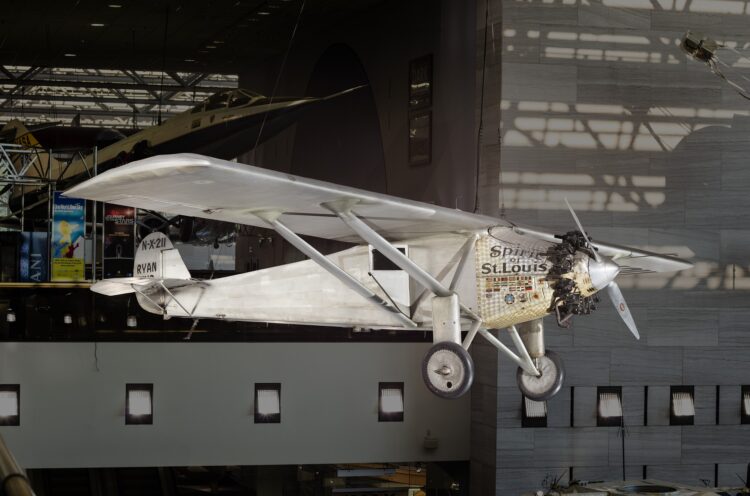
One of the most renowned airplanes in history is The Spirit of St. Louis: a single-engine, single-seat, high-wing monoplane that was famously flown by Charles Lindbergh in 1927. That historic flight was the first solo nonstop transatlantic flight, in which Lindbergh piloted the plane from New York to Paris over 33 hours. What many people don’t know is that the Spirit was designed, built, and tested in San Diego by Ryan Airlines. Perhaps it should have been named The Spirit of San Diego, but alas its financial backing was from St. Louis. Not long after his famous flight, Lindbergh flew the plane to San Diego and was greeted with a hero’s welcome at Balboa Stadium by more than 60,000 San Diegans. You can see a flying replica of the original Spirit at the San Diego Air & Space Museum, and a reproduction of it at the San Diego International Airport.
Ryan NYP “Spirit of St. Louis” on display in the Smithsonian National Air and Space Museum, Washington, D.C., June 29, 2016. Photo by Eric Long.
With the onset of World War II, San Diego’s aviation prowess took center stage. Consolidated Aircraft, later known as Convair, produced the PBY Catalina flying boats which were instrumental in anti-submarine warfare. They also produced the B-24 Liberator heavy bomber during World War II, and many other well-known aircraft after. By the end of the war, San Diego had shifted from a sleepy coastal town to a booming industrial city specializing in aerospace technology. The post-war period saw San Diego becoming a cornerstone in the U.S. defense strategy, thanks to companies like General Dynamics and Ryan Aeronautical. In the 1950s the city became the center of rotary-wing helicopter operations. During the Cold War era, San Diego was at the forefront of technological advancement, developing and producing the nation’s ballistic missiles.
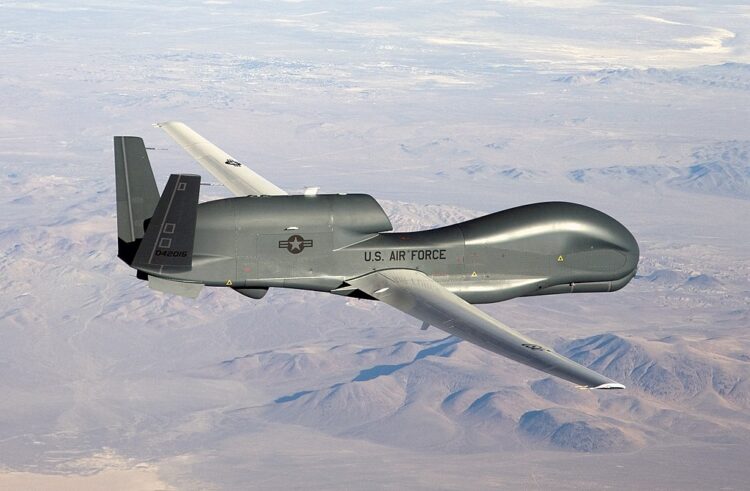
More recently, San Diego became the nation’s capital of the unmanned aerial vehicle (UAV) industry, starting with the Global Hawk developed by Ryan Aeronautical (now part of Northrop Grumman). The turn of the 21st century saw a continued rise of private aerospace enterprises in San Diego. Companies like General Atomics and Northrop Grumman, both having a massive presence throughout San Diego County, have continually broken new ground on everything from drones to state-of-the-art avionics systems.
Northrop Grumman RQ-4 Global Hawk unmanned aircraft. Photo by Bobbi Zapka
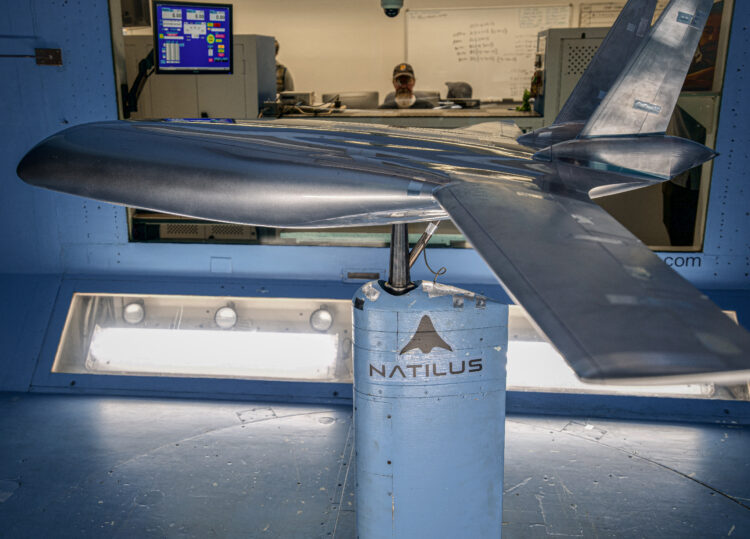
San Diego also has incredible resources, such as the San Diego Low Speed Wind Tunnel (LSWT), now owned and operated by the San Diego Air & Space Museum. The LSWT, located at San Diego’s Lindbergh Field (San Diego International Airport), has been in operation since 1947 and has since conducted about 100,000 hours of testing on military and civil aerospace development programs. Some companies that utilize this one-of-a-kind wind tunnel include Boeing, Cessna, Gulfstream, Lockheed Martin, Northrop Grumman, and Natilus.
Today, Natilus is carrying the torch of San Diego’s rich aerospace history, bringing disruptive technologies to redefine the future of autonomous cargo transport. Our cutting-edge work in blended-wing-body aircraft design promises to revolutionize air cargo transport, making it more efficient and more environmentally friendly.
Natilus Kona wind tunnel testing at the San Diego Low Speed Wind Tunnel
Silicon Valley has software, Los Angeles has entertainment, New York has finance, and San Diego has aviation and aerospace. The city provides access to an abundance of engineering talent and serves as a gateway to a vast network of aerospace resources, ranging from research facilities to military collaborations. Major universities, including San Diego State University and UC San Diego, have prestigious Aerospace Engineering programs educating the next generation of aerospace innovators. Incredible sites like the San Diego Air & Space Museum and historic USS Midway Museum are also inspiring future trailblazers.
We invite you to join us in shaping the future of aviation, right here in San Diego—where aerospace history meets groundbreaking innovation. Learn more about Natilus and view open positions on our Careers page.