San Diego-based company Natilus unveiled the design rendering of Horizon, a blended wing aircraft meant to carry about 200 passengers while producing half the emissions and using 30% less fuel than current Boeing 737 and Airbus A320 aircraft. The CEO of Natilus Aleksey Matyushev joins CNN’s Richard Quest to discuss.
Natilus unveils futuristic plane design that could compete with Boeing 737 and Airbus A320
‘Horizon’ plane’s futuristic shape could revolutionize flying
(CNN) — Spurred by increasing global demand for air travel, aviation emissions have been rising faster than those from rail, road, or shipping in recent decades. Solutions to invert the trend are slow-dripping: Sustainable Aviation Fuel, which can cut emissions of a flight by 80% when produced and used correctly, could represent two thirds of the reduction in emissions needed for aviation to reach its net-zero goal by 2050. But, it’s in short supply and SAF accounted for just 0.3% of all jet fuel use in 2024, a far cry from the levels required to make an impact.
While airlines and regulators scramble for ideas to decarbonize the industry, some engineers are suggesting that an entirely new type of aircraft shape is required to save big on fuel consumption and therefore emissions. This does away with the traditional “tube and wing” design that has been the mainstay of commercial aviation for 100 years, in favor of something called a “blended wing body,” in which the wing area takes up a large portion of the fuselage and creates a distinctive-looking plane.
In 2020, Airbus created a small scale, remote-controlled blended wing demonstrator, to test out a design the company said could save up to 20% of fuel. In 2023, California-based JetZero announced plans for an aircraft with a similar design, with capacity for over 200 passengers and has an ambitious target of entry into service by 2030.
Now, San Diego-based Natilus has joined the race with Horizon, a blended wing aircraft that is also meant to carry about 200 passengers while producing half the emissions and using 30% less fuel than current Boeing 737 and Airbus A320 aircraft — the models it’s aiming to compete with.
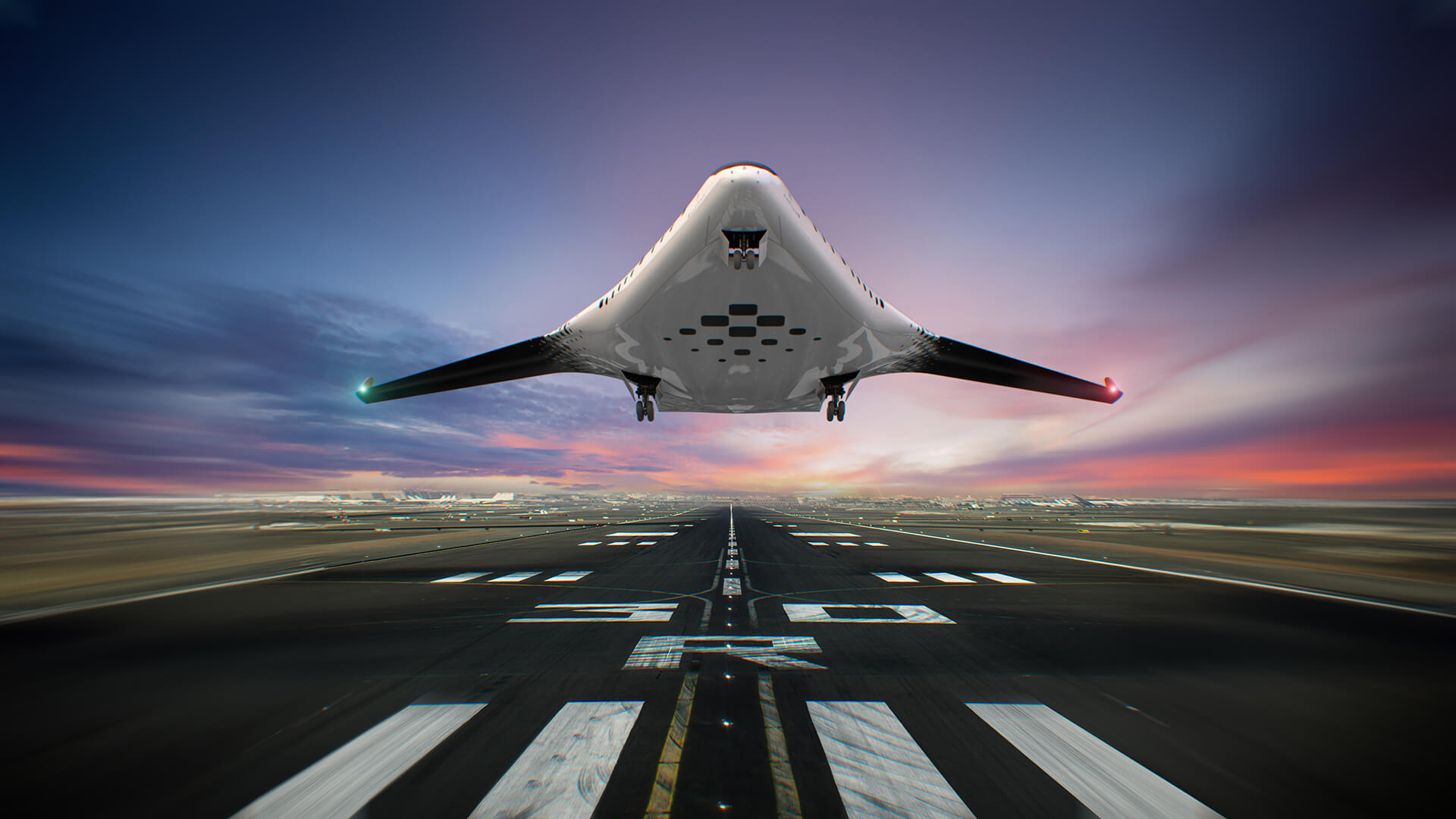
The Natilus Horizon passenger plane aims to reduce emissions by 50%, and increase payload by 40%, due to its blended-wing body shape. Natilus
“The narrow body market, which is exactly where the Horizon fits in, is going to be the biggest market over the next 20 years,” says Aleksey Matyushev, CEO and co-funder of Natilus. “With all the challenges I think the industry is having, for the first time ever, I think there’s an opportunity to build a Boeing or an Airbus lookalike (equivalent).”
A new passenger experience
Natilus, which was founded in 2016, had previously announced a cargo-only, pilotless plane called Kona that also uses the same innovative shape. Matyushev says the blended wing body design originated in the 1990s from McDonnell Douglas, a major American aerospace manufacturer that merged with Boeing in 1997. Boeing never commercialized a blended wing plane, but studied the concept and produced an unmanned prototype, the X-48.
According to Natilus, Kona has received 400 orders and a full-scale model will be built and flown within the next two years. Much of the technology will then transfer to Horizon, which will have a regular cockpit and crew and, according to Matyushev, will enter service by 2030 — a hugely ambitious target, as it would be unprecedented for a brand-new aircraft to go from design to full certification in just six years.
“One of the challenges with the blended wing body design is stability and control,” he explains. “I think that’s where McDonnell Douglas and Boeing really stumbled — how do you stabilize the airplane?”
He says one way to achieve stabilization is via complex flight control systems — essentially computers, which Matyushev points out have caused problems with the Boeing 737 Max.
The other option is aerodynamics, or the design of the plane’s surfaces, which is the route Natilus has chosen and also what differentiates it from JetZero, according to Matyushev.
The new shape comes with some crucial benefits. “There’s a 30% drag reduction, but at the same time, you’re actually able to lower the airplane’s weight to accommodate the same amount of passengers or cargo, which is very unique,” he says. “With a small airplane, you have smaller engines, which create less fuel burn. So when you put the two together, it starts to create a reduction (in emissions) per passenger seat by about 50%.”
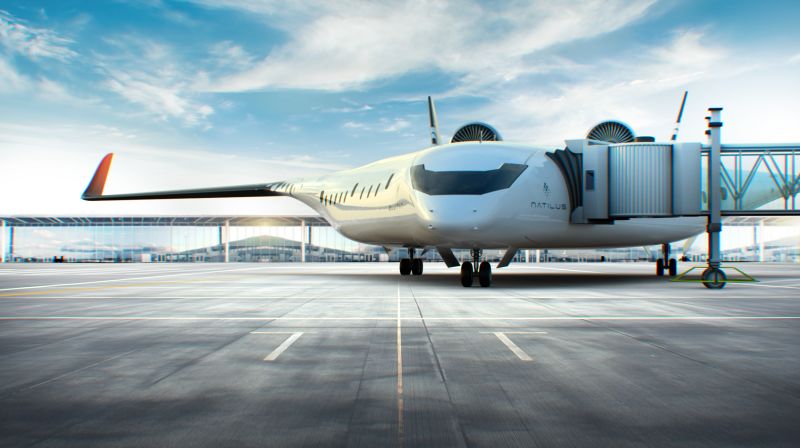
The plane is designed to integrate with existing airport infrastructure, and fit wherever a Boeing 737 or an Airbus A320 would. Natilus
The much larger fuselage, which no longer looks like a tube, opens up possibilities for different layouts on board. “We have about 30% more floor space than a traditional airplane,” Matyushev explains. “So what I think a lot of our customers are thinking about is an elevated passenger experience. Could you bring back the lounge? Are there other spaces in the airplane that you could carve out for those long flights?”
Not everything in Horizon will be brand new; for example, the plane will use existing engine technology, leaving no room for hydrogen or electric options. “There’s a running joke in aviation — never put a brand-new engine on a brand-new airplane. That’s too risky,” Matyushev says. For the same reason, Horizon is designed to fit wherever a Boeing 737 or Airbus A320 would fit, requiring no change in airport infrastructure.
Uncharted territory
According to Gary Crichlow, an aviation analyst at Aviation News Limited, a series of delivery failures that have left airlines waiting for new airplanes well into the 2030s has created a “window of opportunity” for a new entrant to disrupt the status quo.
“That window, however, is very tight,” he says. “A key selling point for operators is commonality in terms of flight crew qualification. The 737 Max and A320neo’s success has been due in no small part to their ability to be integrated easily into existing 737 and A320 operations respectively: flight crews require very little additional training to transition.”
However, teething problems are a feature in every new aircraft and with a new, untested manufacturer and a new, yet-to-be-proven design, that’s pretty much inevitable. “(Horizon) will have a completely different seating and cargo loading plan, and require completely different flight and cabin crew. Avoiding that operational headache, and supporting when it happens, reliably and at scale, is probably the biggest challenge that Natilus will face in convincing potential customers to buy the Horizon instead of holding out for a more traditional 737 Max or A320neo replacement.”

Natilus says the plane would offer a much improved passenger experience due to the larger cabin space. Natilus
Crichlow also flags potential hurdles in the plane’s path to certification with the aviation authorities. “The challenge for any clean-sheet design has always been the tremendous upfront cost to develop and certify it. In terms of certification, conventional aircraft such as the 737 Max 7 and 10, the 777-X, the A321neo XLR and COMAC C919 have all faced, and in some cases are still facing, significant regulatory delays to their manufacturers’ original timelines. With a design as different as the blended wing body, I’d expect regulators to be even more cautious.”
Matyushev is aware that Natilus is entering uncharted territory: “There’s a lot of questions about how you build a blended body at full scale, because all we have is wind tunnel data right now and then scale prototypes, but nobody’s actually built one at full scale,” he says.
With Natilus currently working on a full-scale prototype, some of those questions may soon be answered.
🔗 https://edition.cnn.com/travel/natilus-horizon-blended-wing-aircraft-spc
How Natilus is Designing the Future of Cargo and Passenger Planes from the Ground Up
In this episode of the Tacos & Tech Podcast, host Neal Bloom sits down with Aleksey Matyushev, co-founder and CEO of Natilus, the San Diego-based aerospace company reinventing air freight and passenger travel with next-gen aircraft. With over $39 billion in orders and a growing footprint in South County, Natilus is bringing cutting-edge manufacturing back to San Diego.
Aleksey shares his journey from growing up near a Soviet airfield to becoming an aerodynamicist at Piper and Kratos. He walks us through the founding story of Natilus, early pivots from seaplanes to blended wing bodies, and how customer feedback (and cold emails) helped shape the company’s strategy. Plus, we dive into capital efficiency, certification pathways, and how Natilus is carving out space in a market long dominated by Boeing and Airbus.
Key Topics Covered:
- The legacy of aerospace in San Diego and why Natilus is doubling down here
- Aleksey’s path from Piper Aircraft to Kratos to Natilus
- Lessons learned from military-grade drones and commercial aviation
- The first MVP: a 30-foot autonomous seaplane built in 14 months
- Why cargo came first – and how airlines asked for passenger planes next
- The Kona and Horizon: aircraft designed for freight and people, optimized for fuel, volume, and cost
- Navigating testing, tooling, and certification with just $15M in capital raised
- Why wind tunnels, FAA approvals, and Brown Field are key San Diego assets
- How India became a fast-moving market for commercial orders
- The future of aviation as seen from South County, San Diego
Links & Resources
- Natilus
- Learn more about Rising Tide Partners
Connect with Aleksey & Neal
Natilus Unveils Interior Design for Horizon Blended-wing-body Airliner
Natilus has revealed the interior design for its Horizon blended-wing-body (BWB) airliner, a 200-seat aircraft that the company says could compete with the popular Boeing 737 Max and Airbus A320neo families of narrowbodies in the early 2030s. Thanks to its highly aerodynamic BWB airframe, the Horizon aircraft burns 25% less fuel and can reduce operating costs by half, Natilus claims.
With about the same wingspan as a 737 or A321, the Horizon aircraft boasts 40% more room inside the cabin. Natilus takes advantage of this extra space by improving passenger comfort with larger seats and double-wide armrests. Airlines can also customize their cabins with unique premium features, including video conference pods for business travelers and “deluxe” club-style seating for families.
San Diego-based Natilus collaborated with ACLA Studio, a design firm in Los Angeles, to create an interior that enhances the passenger experience and opens doors to new revenue streams for airlines, Natilus CEO and co-founder Aleksey Matyushev told AIN. He said Natilus’ airline customers—which the company has not yet disclosed—have expressed interest in a “business center” consisting of three private video conference pods in the back of the aircraft. Passengers would pay to reserve time inside the pods.
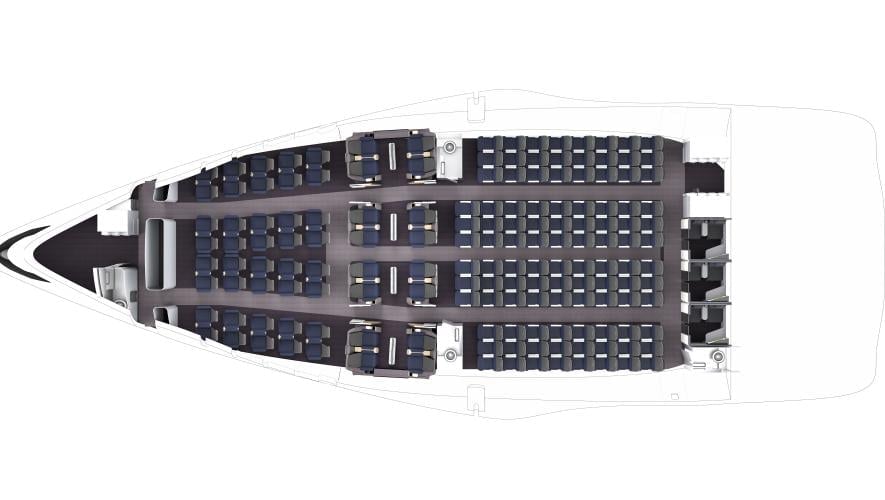
Airlines will be able to customize the cabin configuration with various combinations of economy, premium economy, and business class seats. With 20-inch-wide seats in a 3-3-3-3 configuration in economy class, there isn’t enough room for budget carriers to add more seats to each row, Matyushev explained.
Natilus’ proposed layout of passenger accommodations (LOPA) for high-density configurations features nine rows of economy seats with a 31-inch pitch and five rows of first-class seats with a 38-inch pitch. In the middle of the aircraft are either four sets of four club-style family seats or four rows of 34-inch-pitch premium economy seats.
One drawback of the blended-wing design is that a vast majority of passengers will have no windows in sight. In the Horizon LOPA, only the first five rows of first-class seats have windows. To make up for the lack of windows in the rest of the cabin, Natilus is equipping the Horizon with an intelligent lighting system that can coordinate with in-flight entertainment display screens to simulate the outside world.
The Horizon aircraft has a range of 3,500 nm and can seat up to 200 passengers. © Natilus
The Horizon aircraft, Natilus’ flagship product, will be a larger follow-on to the Kona cargo freighter that the company plans to certify by 2028. Natilus is currently building the first full-scale prototype of the Kona BWB aircraft and aims to begin flight testing in 2026. The company has not yet disclosed its customers or the amount of capital it has raised, but it claims to hold a backlog of orders for 580 aircraft, worth a total of up to $23 billion.
Natilus is not the only BWB airframer seeking to disrupt the Boeing-Airbus duopoly. Last month JetZero, another California-based aircraft developer, took the wraps off its plans for the Z4, a 200- to 250-passenger aircraft called the Z4. Canadian business jet manufacturer Bombardier is studying a smaller Global 6000-sized BWB aircraft with its EcoJet research and development program, which has already flown two subscale demonstrators.
Natilus Debuts Revolutionary Interior Design for the HORIZON Blended-Wing Passenger Aircraft
- The 200-passenger HORIZON offers 40% more space than Boeing 737 MAX8
- Video Conference pods create a ‘work-from-sky’ experience with private video-enabled work spaces
- Deluxe Club Seating enables family-friendly two-by-two pairings in clusters of four to allow family and friends to travel and socialize together
SAN DIEGO, July 1, 2025 /PRNewswire/ — Natilus, a U.S. aerospace manufacturer of blended-wing body aircraft, today unveiled the much-anticipated interior design for its flagship 200-passenger aircraft, the HORIZON, which is designed to elevate passenger air travel and serve as a competitor to the Boeing 737 MAX and Airbus 321 NEO in the narrowbody space.
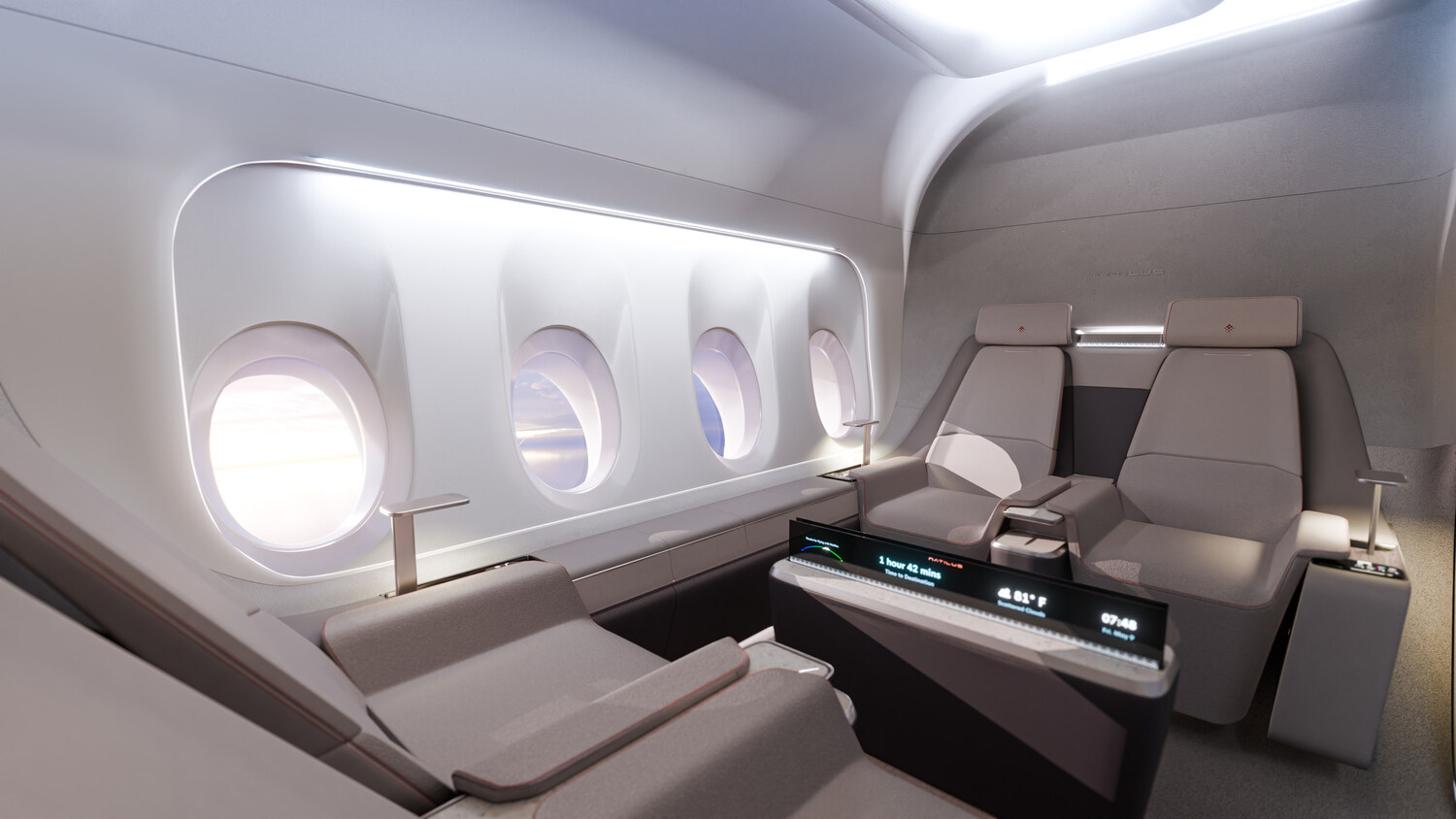
Deluxe Club Seating allows for passengers to sit two-by-two facing each other, perfect for families traveling with small children.
Natilus’s BWB design offers 40% more interior capacity, which the HORIZON utilizes to make air travel more comfortable and enjoyable. Intended to have a largely customizable layout to meet the needs of each individual airline and its customer base, the HORIZON is reimagining what air travel can be with the introduction of innovative spaces for business travelers to families.
Work from the Sky in HORIZON’s Video Conference Pods
For the first time on commercial aircraft, the HORIZON will be equipped with three video conference pods that act as conference rooms for the business-oriented passengers. The pods will be compatible with both video and phone calls and will be Wi-Fi-enabled, so that passengers can continue to collaborate and be productive during flight.
Families Take Center Stage with Club Seating
The HORIZON will also include Deluxe Club Seating, where a family of four can comfortably sit two-by-two facing each other, making it easy to communicate, play, and share experiences throughout the flight. No longer limited by the dreaded middle seat, the club seating is attractive for airlines looking to cater to family units with small children.
Intelligent Lighting Connected to Infotainment
The HORIZON will be equipped with an intelligent lighting system with simulated skylights and windows that can be customized to a seating zone, mimicking natural light or ambient lighting to ease the impact of jetlag. The lighting can also be coordinated with the infotainment screens to create an immersive entertainment experience.
HORIZON: Benefits of 40% More Capacity
With its unique blended-wing body design, the dramatic gains in interior cabin space translate to an entirely new experience for passengers. In this new design, the HORIZON boasts:
- Luxe, lie-flat first class seats that allow travelers to rest during long-haul flights, evoking a sense of a private retreat;
- Economy seats where every passenger enjoys their own dedicated seat with back-of-seat infotainment systems, featuring a wide selection of movies, music, and connectivity options to make the journey as enjoyable as it is efficient;
- Tall ceiling heights at 7.5 feet to make the cabin feel even more spacious; and
- Eight exit doors for ease of egress, with the possibility for carriers to opt for double doors.
“The HORIZON is an innovative aircraft that ushers in a new era of air travel, offering significantly more interior space—which we’ve used to create a more comfortable and enjoyable cabin,” said Aleksey Matyushev, CEO and Co-founder of Natilus. “This aircraft will provide our commercial airline customers with the ultimate platform to elevate the passenger experience.”
Source: 🔗 PR Newswire
Natilus Unveils Horizon BWB Cabin Configuration Details
California-based startup Natilus has revealed the first interior layout details of its planned 200-seat Horizon blended wing body (BWB) airliner, which aims to maximize the available volume with novel features such as “privacy pods,” club-style seating with tables and simulated skylights.
The Future Of Cargo? Kuehne+Nagel Eyes Blended Wing Freighter
Keuhne+Nagel, a major shipping company, has partnered with Natilus, which is developing a blended-wing body (BWB) aircraft, to explore the possibilities of deploying such aircraft in the air cargo sector.
However, the two companies did not disclose an order. Natilus previously indicated that it has secured over 460 orders for the Kona, an autonomous cargo aircraft that can carry a payload of up to 3.8 tons (3.4 tonnes).
Strategic Partnership

On May 28, Kuehne+Nagel, the Switzerland-based logistics company, which has an air cargo subsidiary with a single Boeing 747-8F, the last-ever 747 that the plane maker delivered in January 2023, announced a partnership with Natilus, a United States-based startup that aims to build commercial passenger and cargo aircraft.
The shipping giant said that the partnership will entail studies of Natilus’ BWB aircraft and its environmental, economic, and operational impact of integrating the to-be aircraft into commercial air freight operations.
“Leveraging its knowledge of the air logistics industry, Kuehne+Nagel will collaborate with Natilus to explore the operational feasibility of implementing its aircraft within the industry, focusing on route modelling, environmental impact assessment, operational cost analysis, and engagement with the aviation industry.”
Reducing Fuel Consumption, Improving Payload

Keuhne+Nagel claimed that Natilus was the first company to commercialize a BWB design, with the startup, founded in 2016, looking to develop an aircraft family that would reduce fuel consumption by 30% and increase payload by 40%, without providing the baseline for the comparison.
“Together, the companies will assess how blended-wing-body aircraft will operate within existing fleets to improve logistics efficiency, enhance service offerings, and reduce carbon emissions in freight forwarding,” Keuhne+Nagel said, adding that it has been actively exploring opportunities to become more sustainable for its customers.
Holger Ketz, the Senior Vice President of Network and Carrier Management of Air Logistics at Kuehne+Nagel, stated that the company has always led the way in making air freight logistics more sustainable. Its collaboration with Natilus is just another example of how it is exploring new technologies for more environmentally friendly and cost-effective air freight solutions. Aleksey Matyushev, the founder and Chief Executive Officer (CEO) of Natilus, said that the partnership with the shipping company is “a meaningful step in helping the industry better understand the powerful advantages of blended-wing-body aircraft, which will become a blueprint for other logistics companies over the next decade.”
Looking For A Production Site

So far in 2025, developments for Natilus have been limited. In addition to a partnership announcement with Palantir, a company that has close ties with the Donald Trump administration, including a $30 million contract to track migrants and their self-deportation and deportation logistics, the company has also begun searching for space to build its manufacturing facilities.
On March 25, the company said that it has begun the process of selecting a potential site for the assembly of its aircraft to produce its BWB freighter Kona and the 200-passenger Horizon BWB commercial aircraft. “New tariffs on critical materials are expected to exacerbate aviation supply chain challenges and further delay deliveries of cargo and passenger aircraft to US airlines,” it said, highlighting that by establishing its facilities in the US, it is well-positioned to mitigate the impact of potential trade restrictions and supply chain restrictions.
🔗 https://simpleflying.com/the-future-of-cargo-kuehnenagel-eyes-blended-wing-freighter/
Start-up Natilus ‘talking to everyone’ in search for US manufacturing site
Start-up aircraft manufacturer Natilus has started looking for places to build large-scale facilities that will produce its proposed blended wing-body (BWB) aircraft.
Founder and chief executive Aleksey Matyushev told FlightGlobal on 21 March that the San Diego-based firm is purposefully looking within the USA for building its first plant, partially to avoid supply-chain disruptions related to US tariffs on critical materials.
But that is far from the company’s only consideration in selecting a site.
“We’re talking to everyone,” he says. ”Talent pool is a big part of where we can scale; land is also very important for us.”
The first phase of the project involves Natilus building a 23,226sq m (250,000sq ft) facility where it will build its Kona cargo aircraft.
But the long-term vision is to scale production dramatically with a second 232,258sq m facility to produce its planned 200-passenger commercial aircraft, Horizon.
Natilus has lofty ambitions of disrupting decades of dominance by Airbus and Boeing by delivering its passenger aircraft Horizon – which is now still a concept – to airline customers next decade.
But it plans to start smaller with Kona, an optionally piloted cargo aircraft with a targeted payload of 3,800kg (8,378lb) and range of 900nm (1,667km).
Both Horizon and Kona will feature a BWB design – which, if achieved, would represent a radical break from the tube-and-wing configuration.
First, it must build a production facility. The company is considering cities with existing aerospace industries, though Matyushev is wary of getting too close and “competing for talent against some of the bigger giants”.
That may leave Natilus building its factories in proximity to automotive manufacturers that are well versed in producing carbon-fibre components.
Yet another factor is tapping into a cheap supply of electricity. “Where are the hydro plants in the United States? What does the US grid look like? This is all part of the process, which is very data-driven,” he says.
Asked whether Natilus might follow the lead of electric air taxi maker Joby Aviation in targeting a Heartland state for manufacturing, Matyushev says, “There might be a surprise”.
Natilus expects to finalise the site for its first aircraft production facility sometime within the next 12-18 months.
The second facility, for producing the larger Horizon jets, could be located adjacent to the Kona factory – or perhaps somewhere outside the USA. Matyushev points to India and Japan as possibilities.
“As we start thinking about global expansion plans, even if the airplanes are manufactured here, the amount of capacity and need for aircraft is just so vast,” he says. “Having a second plant, or even the first location overseas, might make a lot of sense.”
“Package it all together, and we’re looking for vast amounts of land and, more importantly, an airfield,” Matyushev says. “As we start thinking through it, a lot of the heartland states have land available but the talent pool kind of brings us back into other locations as well.
“Having more localised ecosystems and the talent pool, I think, is probably the most important for us.”
CARBON CAPTURE
Natilus is eyeing warily the escalating trade war between the US and longtime allies. But Matyushev says the company does not currently anticipate a major impact from US President Donald Trump’s tariffs on steel and aluminium.
“Natilus has primarily carbon aircraft, so we’re not affected by anything of that nature quite yet,” he says. “We’re watching it closely, but as for today, we don’t seem to be affected.
”Even if the cost is 20-30% more, it doesn’t seem to really make or break anything that we’re working on today.”
Most carbon composite material used for aerospace manufacturing is sourced from Japan – a country that has yet to be drawn into the trade war.
“A lot of their R&D and initial manufacturing [of carbon composites] is usually done in plants in Japan,” Matyushev says. “They seem to have gotten really great it, in terms of the chemistry behind it.”
Japanese company Torray Industries produces much of the carbon material used in Boeing 787s, for example.
Matushev says the aerospace industry’s complex, multinational supply chain represents a challenge – especially in the current environment of uncertainty – and that it would advantageous to build aircraft near suppliers.
Natilus does not yet possess major manufacturing infrastructure, such as autoclaves for baking carbon composite components. But the plan is to slowly ramp up its supply chain and manufacturing capabilities over the next several years.
“On the baking side of carbon fibre, we eventually want to bring that in-house,” he says.
Natilus has already acquired a significant amount of carbon-fibre material from US-based partner Janicki Industries. That material will be used to manufacture the major aerostructures for its first Kona aircraft and is currently being stored in coolers.
“They purchase vast amounts of carbon,” Matyushev says of Janicki. “We slotted ourselves just as a small subset of that large purchase order. It’s enough for the first aircraft, because carbon does have an expiration date.”
Natilus intends to fly a full-scale prototype of Kona within the next two years, and to start producing the type for cargo customers before the end of the decade.
Kuehne+Nagel and Natilus partner to bring blended-wing aircraft to commercial air freight
SCHINDELLEGI, Switzerland and SAN DIEGO, May 28, 2025 /PRNewswire/ — Kuehne+Nagel, one of the world’s leading logistics providers, and Natilus, an aerospace manufacturer of blended-wing-body aircraft, today announced a strategic partnership to study the environmental, economic, and operational impact of integrating Natilus’s hyper-efficient blended-wing aircraft into commercial air logistics operations.
Leveraging its knowledge of the air logistics industry, Kuehne+Nagel will collaborate with Natilus to explore the operational feasibility of implementing its aircraft within the industry, focusing on route modelling, environmental impact assessment, operational cost analysis, and engagement with the aviation industry.
The first to commercialise blended-wing-body design, Natilus is developing a family of aircraft designed to unlock improved aviation economics by reducing fuel consumption by 30% while increasing payload capability by 40%. Together, the companies will assess how blended-wing-body aircraft will operate within existing fleets to improve logistics efficiency, enhance service offerings, and reduce carbon emissions in freight forwarding.
Kuehne+Nagel is actively exploring opportunities to implement more sustainable business practices for their customers. The logistics partner for 400,000 customers worldwide, Kuehne+Nagel is pursuing innovations, such as looking into new airframe designs to reduce the environmental as well as the economic impact of air freight.
“At Kuehne+Nagel, we have consistently led the way in making air freight logistics more sustainable and this collaboration with Natilus is another example of how we continue to explore new technologies for more environmentally friendly and cost-effective air cargo solutions,” said Holger Ketz, SVP Network and Carrier Management Air Logistics at Kuehne+Nagel.
Committed to delivering a comprehensive assessment of the potential CO2e emissions saved, Kuehne+Nagel and Natilus will partner with select air freight carriers to demonstrate benefits of complementing existing fleets with blended-wing-body aircraft.
“Our partnership with Kuehne+Nagel is a meaningful step in helping the industry better understand the powerful advantages of blended-wing-body aircraft, which will become a blueprint for other logistics companies over the next decade,” said Aleksey Matyushev, Co-Founder and CEO at Natilus. “We look forward to collaborating with Kuehne+Nagel and integrating our family of blended-wing-body aircraft into its world-class global logistics network to redefine efficiency and sustainability in freight.”
About Kuehne+Nagel
With more than 82,000 employees at almost 1,300 sites in close to 100 countries, the Kuehne+Nagel Group is one of the world’s leading logistics providers. Headquartered in Switzerland, Kuehne+Nagel is listed in the Swiss blue-chip stock market index, the SMI. The Group is the global number one in air and sea logistics and has strong market positions in road and contract logistics. Kuehne+Nagel is the logistics partner of choice for 400,000 customers worldwide. Using its global network, logistics expertise and data-based insights, the Group provides end-to-end supply chain solutions for global companies and industries.
Natilus signs deal with Palantir to speed production
Autonomous aircraft builder Natilus will work with software provider Palantir Technologies to accelerate the production of its blended wing body freighter and passenger aircraft design. Publicly traded Palantir will collaborate with Natilus to design an AI-driven operating system to reduce the production and delivery timelines for the Kona freighter and Horizon passenger aircraft