Former Head of Global Fleets for Amazon Air Joins Blended-Wing Pioneer Natilus’s Advisory Board
SAN DIEGO, March 5, 2026 /PRNewswire/ — Natilus, a U.S. aerospace manufacturer of blended-wing-body aircraft (BWB), today announced the appointment of Mylène Scholnick, a global aviation executive and former Head of Global Fleet Management at Amazon Air, to the Natilus Advisory Board. Scholnick will provide strategic guidance as Natilus advances KONA, its next‑generation regional BWB aircraft designed to transform air cargo economics and sustainability.
As global air freight operators seek solutions that reduce fuel burn, expand payload capacity, and lower operating costs, blended‑wing‑body technology is emerging as a breakthrough platform. Natilus’s KONA aircraft delivers a 30% reduction in fuel consumption, 50% lower operating costs, and a 40% increase in payload capacity, offering a step‑change improvement over current airframe design.
Scholnick brings more than 25 years of leadership across aerospace, fleet strategy, aircraft finance, and global operations. At Amazon Air, she built and led Global Fleet Management, scaling the fleet from 36 to 115 aircraft across North America, Europe, Canada, and India. She directed Amazon’s aircraft and engine procurement strategy, managed billions in transactions, and launched the company’s first aircraft and engine purchase and conversion programs.
“My career has been dedicated to advancing the global aviation industry,” said Mylène Scholnick. “I am delighted to join the Advisory Board of Natilus, whose blended-wing-body technology represents one of the most compelling clean sheet opportunities our sector has seen in decades. At a time when incumbent OEMs are focused on production recovery rather than next generation design, Natilus is charting a bold path that could reshape long term fleet strategy, efficiency, and sustainability.”
On the heels of its $28 million Series A close, Natilus adds Scholnick to a distinguished Advisory Board, which includes the following:
Dennis Muilenburg, former President and CEO of The Boeing Company and current CEO of New Vista Capital
Kory Mathews, former VP of Phantom Works and VP and Chief Engineer of Boeing Military Aircraft
Brent Wouters, former CEO of Cirrus Aircraft, the largest producer of general aviation aircraft in the United States
Ram Menen, an original member of the Emirates founding team and former head of its cargo division
Natilus’s order book stands at 570 aircraft, valued at $24B. Notable customers include Canadian charter airline Nolinor Aviation, SpiceJet, Flexport, and Ameriflight. The company will select its first domestic manufacturing site for KONA later this year.
“As we work towards KONA’s first flight in the next 24 months, we are at a pivotal point for the company, which is why it is critical that we build a team with decades of experience across the aviation industry,” said Aleksey Matyushev, CEO and Co-Founder of Natilus. “Mylène’s deep expertise in fleet strategy, procurement, and global operations – combined with her track record of building aviation programs at scale – will be instrumental as we advance development and prepare for production of KONA.”
This San Diego company says it’s building the next Boeing
Natilus has made a string of announcements, including news of a $28 million funding round, new renderings of its commercial aircraft and the appointment of an ex-Boeing executive to its board.
In a hangar 1½ miles from the Mexican border, airplane parts lay scattered across a concrete floor. Rising from the center of the bay is a Star Wars-style cockpit, neon-lit and hissing as the door opens to reveal a dashboard equipped with self-flying software. Orange tape on the floor traces where a wing will eventually end, while the real thing lies in front of the hangar — its multicolored cords exposed like veins.
Taken together, the pieces form a glimpse of aviation’s next chapter.
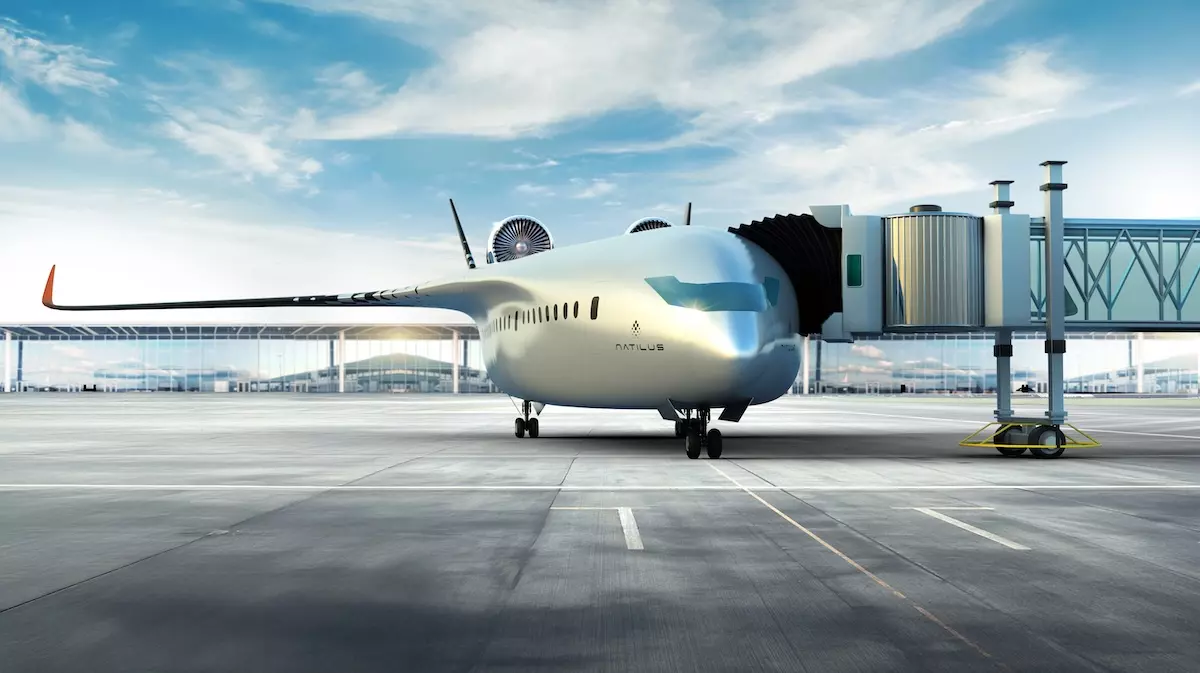
San Diego aerospace company Natilus recently debuted designs of its sleek, triangular commercial aircraft. The blended-wing-body plane — which kind of looks like a manta ray — requires 30% less fuel, cutting operating costs in half.
Renderings of the Horizon commercial aircraft, reviewed by the Federal Aviation Administration. (Natilus)
The new renderings are just one announcement of many this month. Natilus also secured $28 million in funding — for both its commercial and cargo plane — and added a high-profile executive to its board.
“We’re going to be the next Boeing,” said Aleksey Matyushev, CEO and co-founder of Natilus — and now he’s building the board to match that ambition. A former Boeing executive joined the board of directors, and more aerospace insider appointments will be announced in the coming months, Matyushev said.
While competition forms on the ground, it will be a few years until Natilus takes to the sky.
Today, the company is piecing together its first cargo plane, the Kona, for a test flight scheduled for 2028. The commercial passenger aircraft, the Horizon, will have its first test flight a year later.
If all goes to plan, both planes should take off in the early 2030s.
A one-tenth scale model of the startup’s cargo plane — called the Kona — is used for wind-tunnel tests. (Howard Lipin / For The San Diego Union-Tribune)
Progress paused
Traditional tube-and-wing airplanes have been circling the globe for 60 years, and Matyushev says it’s time for a change. The blended-wing-body concept has been explored since the 1920s — NASA and Boeing researched it in the 1990s.
“Nothing is stopping Boeing from developing a blended-wing-body airplane. There is nothing stopping Airbus from doing something like this, short of obviously imagination and a willingness,” said Henry Harteveldt, airline analyst at Atmosphere Research Group.
Boeing and Airbus already have backlogs of current models spanning years, and it takes billions of dollars to bring a new airplane to market. There is no incentive to innovate, Matyushev said.
Matyushev and co-founder Anatoly Starikov saw this stagnancy firsthand. They both worked in aviation and aerospace for almost a decade before they decided to innovate on their own.
Their “aha moment” came with the rise of Amazon and e-commerce, said Matyushev. Airplanes would often max out on space before they reached the weight capacity. It was time to design a better plane.
Natilus, founded a decade ago, is working on new designs for the Horizon, its commercial passenger aircraft. (Natilus)
Built differently
Recently released renderings of Natilus’ new plane show a double-decker design with seating for up to 200 passengers above a cargo cabin.
Commercial airlines can customize their floor plans, and Natilus offered ideas, like face-to-face four-seat configurations and video-conference pods.
That flexibility is enabled by scale: the Horizon offers about 40% more cabin space than a Boeing 737 or an Airbus A321, according to the company.
And while the design is innovative, much of the infrastructure is not. Natilus will use existing engines and airport facilities, ensuring easier compliance with safety standards and airport operations.
Renderings of a face-to-face seating configuration for the Horizon passenger aircraft. (Natilus)
Rivals in flight
Today, Natilus has a backlog of 580 aircraft orders, valued at up to $23 billion. Customers include commercial carriers such as Indian low-cost carrier SpiceJet, regional cargo operator Ameriflight and Nolinor Aviation, a charter airline based in Montreal.
Matyushev hinted at an additional potential airline partnership.
But Natilus isn’t the only one vying to build a better plane.
One hundred miles north, JetZero is experimenting with blended-wing-body aircraft in Long Beach. So far, the company has announced partnerships with Delta Air Lines, United Airlines, Alaska Airlines and the U.S. Air Force.
Despite surface-level similarities, Matyushev pushed back on the idea that JetZero is a direct competitor. “Just because it looks like we have the same airplane doesn’t make us competitors,” Matyushev said, noting that his Horizon plane targets a smaller aircraft segment serving a different market.
“There’s plenty of room for all of us,” Matyushev said. “The more successful they are, the more successful we’re going to be.”
But, “partnerships mean nothing at this point,” said Harteveldt. “They’re nice to have. You can put logos on your pitch deck … but at this point, if you were to talk to Delta or United, they’d say, ‘Yeah, we’re interested in what JetZero is doing. But if Natilus comes out with something better, we’re going to order it.’”
Aleksey Matyushev, co-founder and CEO of Natilus. He said their “aha moment” came with the rise of Amazon and e-commerce. Airplanes would often max out in space before they reached the weight capacity. (Howard Lipin / For The San Diego Union-Tribune)
The cabin crew
The lead investor of Natilus’ latest fundraising round is Tim Draper of Draper Associates. His firm manages more than $2 billion and has backed several unicorns, including Coinbase, Skype, Robinhood and Tesla.
“He was a big believer early on, especially when there’s a duopoly,” Matyushev said. “He hates a duopoly.”
But breaking the Boeing-Airbus dominance will take more than the $33 million Natilus has raised so far.
Matyushev acknowledged that. It takes $7 billion to deliver a new commercial aircraft and about $250 million to create a cargo plane.
“We know you can’t go raise $10 billion right away. We had to start small,” he said, explaining the true value of the latest fundraising round wasn’t the dollar amount, but the strategic partnerships it brought. “All of our investors work with us day to day. That’s the difference.”
One of those partners comes from Boeing’s highest ranks. Dennis Muilenburg, the former CEO of Boeing, invested through his firm, New Vista Capital. The firm’s senior partner, Kory Mathews, also a former senior Boeing defense executive, recently joined Natilus’ board.
While experienced leadership will help, the hardest part is still ahead.
The propellers that will be used on an aircraft being developed by the startup Natilus. (Howard Lipin / For The San Diego Union-Tribune)
Manufacturing a fleet
They are doing site selection this year for the first 250,000-square-foot Kona factory and then a 3.5 million-square-foot phase‑two facility that could bring 11,000 jobs.
“They’re going to have to find the physical space, and it’s not just land. It’s going to require a huge amount of infrastructure, power, water and roadways, of course, but also railroad access, because some of these parts may need to be transported by train,” said Harteveldt.
He flagged a few states where Natilus may land: Texas is “a very business‑friendly” state; Wichita, Kansas, has a strong aviation manufacturing history; Missouri has ties to the St. Louis/McDonnell Douglas legacy.
And then, of course, there is San Diego, which has its own aerospace legacy.
“Obviously, we are talking to the city. Brown Field has got an incredible amount of space … But the city moves slow. California can be a little bit more challenging for these types of things,” said Matyushev. “But we are talking to the right folks to see if we could make it happen.”
For now, their 40 employees are working on building a single plane 1½ miles from the Mexican border, where there is plenty of space for manufacturing sprawl.
San Diego has a long history in aerospace and aviation. From North Island’s military aviation school, generations of engineers and airfields have grown. But with 21st‑century costs and regulations, “I can’t imagine they would choose to manufacture in California first,” said Harteveldt.
Natilus Raises $28M to Develop Next-Generation Aircraft
San Diego-based aerospace manufacturer Natilus has closed a $28 million Series A round led by Draper Associates with participation from Type One Ventures, The Veterans Fund and Flexport. New investors include New Vista Capital, Soma Capital, Liquid 2 VC, VU Venture Partners, and Wave FX. Natilus is adding world-class aviation veteran and former Boeing executive, Kory Mathews, to its board of directors.
“There’s a shortfall of 15,000 commercial airplanes. We need to modernize the United States to build a modern OEM,” said Aleksey Matyushev, co-founder and chief executive of Natilus. “We bring cutting-edge technology to increase the product margins while increasing the manufacturing base in the United States.
The fledgling startup employs 20 people and expects that number to double within the next several months. The company has 570 orders for planes worth an aggregate of $24 billion from public airlines across the world. It flew a prototype last year and has conducted testing that gives its customers confidence in its delivery of aircraft. Commercial deliveries could begin in the early 2030s.
“We use existing engine technology with a new airframe. Our first product is only for air freight and then will add a passenger jet,” said Matyushev.
Natilus is focused on a blended-wing-body platform that Leverages improved aerodynamics, capacity and efficiency. Its aircraft cut fuel usage by 30% and carbon emissions and operational costs by 50%. This latest funding will allow it to complete manufacturing of its first full-scale prototype regional cargo plane, KONA, which is expected to fly in the next 24 months. It is actively pursuing FAA Part 23, Amendment 64 certification for KONA and is determining a location for its 250,000 square feet manufacturing site to build 60 KONA per year.
Based on feedback from the FAA and global carrier customers, Natilus evolved its EVO passenger plane from a single-deck to a dual-deck aircraft, which offers more practicality in design, build and operations. The passenger jet is intended to compete with the Boeing 737 MAX and Airbus A321-neo with a configuration of 165 for international flights and could expand to 250 people for high density, shorter flights.
Founded in 2016, the Natilus team is composed of former employees from Boeing, General Atomics, Northrop Grumman, Skunkworks, SpaceX and Piper Aircraft.
Natilus Unveils New Enhancements to its Hyper-Efficient HORIZON EVO Passenger Aircraft as it Readies For FAA Certification and Commercial Fleet Integration
Critical feedback from FAA and carrier customers addresses certification requirements
Design includes new dual-deck cabin, improved egress, and faster turnaround times
HORIZON EVO fits seamlessly into existing airport infrastructure and operations
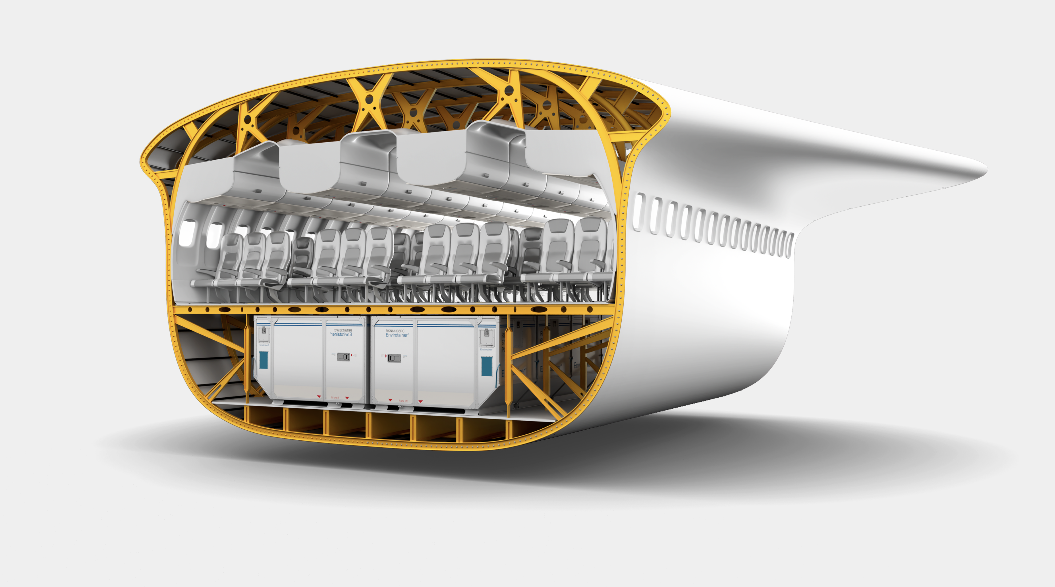
HORIZON EVO evolves from a single-deck to a dual-deck aircraft, offering enhanced passenger space and safety with seamless ground interoperability. Cross section shows design modifications to accommodate standard cargo containers without hampering space for passenger seating.
SAN DIEGO, Calif. – February 10, 2026 – Natilus, a U.S. aerospace manufacturer of blended-wing-body aircraft (BWB), today reached a critical milestone as it readies its passenger plane, HORIZON EVO, for commercial certification and fleet integration. Based on key feedback from the Federal Aviation Administration (FAA) and its base of global carrier customers, the HORIZON EVO design has evolved from a single-deck to a dual-deck aircraft. These enhancements offer more practicality in design, build, and operations – while improving overall passenger experience and safety. HORIZON EVO will enter commercial service in the early 2030s.
“In our ongoing conversations with the FAA and customers, there’s real excitement around what our new airframe brings, not only in terms of fuel economics, but in addressing some of the recent and real pain points happening in aviation today around safety, passenger experience, and plane shortages,” said Aleksey Matyushev, Co-Founder and CEO of Natilus. “These airline-validated insights really drove the design enhancements around dual-deck practicality, egress certifiability, and turnaround times and put us on a clear path to commercial certification.”
Natilus’s vision for the commercial-ready HORIZON EVO is centered on three key design pillars which maintain interoperability with existing airport ground infrastructure, while implementing modifications to the profile and interior that substantially enhance passenger experience and safety.
Key Design Pillars:
Dual-Deck with a Focus on Safety: Mirroring the dual-deck layout of existing narrowbodies, HORIZON EVO offers both a spacious upper deck cabin for passengers and a lower deck for standard cargo containers, pressurization advancements for comfort, and improved access to emergency exit paths.
More Overhead Storage Space and Windows Throughout the Cabin: Addressing a rising pain point for carriers, HORIZON EVO’s dual-deck design provides increased overhead storage. The spacious upper deck also reflects customer demand for more window seats, novel for the BWB.
Improved Turnaround Times & Seamless Infrastructure Interoperability: The HORIZON EVO design maintains its purpose-built fit with existing passenger and cargo ground infrastructure and now includes the ability to carry standard air-freight containers in its lower deck. Multiple aisles in premium and economy cabins further ease loading and passenger flow.
“The commercial aviation industry is facing a fast-approaching reckoning in which demand for new airplanes far exceeds current production capacity, with global fleets forecasted to double over the next 20 years, driving the need for more than 40,000 airplane deliveries,” said Dennis Muilenburg, CEO of New Vista Capital and former Chairman & CEO of The Boeing Company. “We believe HORIZON EVO presents a highly attractive transformative design at the leading edge of that solution.”
# # #
About Natilus Natilus is a U.S.-based company developing a family of hyper-efficient blended-wing-body (BWB) aircraft designed to transport people and cargo more sustainably and efficiently than ever before. With over 570+ aircraft pre-orders valued at $24 billion, Natilus is commercializing its BWB aircraft that unlock improved aviation economics—reducing fuel consumption by 30% and operational costs by 50% while increasing payload capacity by 40%. Founded in 2016, the Natilus team is composed of innovators from General Atomics, Northrop Grumman, Skunkworks, SpaceX, and Piper Aircraft. Learn more at natilus.co.
Natilus Raises $28 Million Series A to Commercialize Family of Hyper-Efficient Blended-Wing Aircraft
New capital will support the first full-scale flight of KONA, a next-generation regional freighter for commercial and defense logistics
Its passenger aircraft, HORIZON EVO, will enter commercial service in the early 2030s
Former Boeing Military Aircraft and Phantom Works exec joins Board of Directors to advance rapid prototyping and commercialization
SAN DIEGO, Calif. – February 10, 2026 – Natilus, a U.S.-based aerospace manufacturer of blended-wing aircraft, today announced it has secured $28 million in Series A financing. The financing was led by Draper Associates and includes strategic investors with focuses on aerospace, defense, and global freight logistics including: Type One Ventures, The Veterans Fund, and Flexport. Also participating are new investors New Vista Capital, Soma Capital, Liquid 2 VC, VU Venture Partners, and Wave FX.
Natilus has attracted broad buy-in across defense, air freight and commercial aviation markets for the game changing economics that its blended-wing-body platform enables. Leveraging improved aerodynamics, capacity, and efficiency, its family of blended-wing aircraft cut fuel usage by 30% and carbon emissions and operational costs by 50%. This latest funding will allow Natilus to complete manufacturing of its first full-scale prototype of regional cargo plane KONA, which is expected to fly in the next 24 months. Natilus will also further invest in the development of its second aircraft, HORIZON EVO, a 200+-passenger aircraft intended to compete with the Boeing 737 MAX and Airbus A321-neo. Today, Natilus also debuted its transition from a single-deck to a dual-deck aircraft, implementing modifications to the profile and interior that substantially enhance passenger experience and safety.
Global aircraft demand has outpaced the combined production capabilities of Boeing and Airbus – leaving a shortfall of 15,000 planes that must be met over the next 20 years to satisfy global need. As a result, the market is hungry for a new manufacturing entrant that can navigate supply chain constraints and deliver a superior aircraft.
In the last 12 months, Natilus has made significant progress on its IP family and national manufacturing efforts. In July, it was awarded a patent for KONA’s diamond-shaped cargo bay and in March, it initiated the launch of its first domestic manufacturing to produce KONA. Currently, Natilus’s commercial product order book stands at 570+ aircraft, with reservations from major players like SpiceJet, Nolinor Aviation, Flexport, and Ameriflight – and is valued at $24 billion.
In addition to strong demand from domestic and global carriers, Natilus’s optionally-piloted KONA is gaining interest for its potential defense applications. With its 3.8 ton payload capacity and ability to land on shorter, gravel runways, KONA can provide intra-theater lift and transport cargo to remote locations more efficiently than ever before. The cargo freighter can support Agile Combat Employment (ACE) and logistics resupply in highly contested and austere regions such as the Indo-Pacific. Natilus has engaged in conversations with the U.S. Army, U.S. Air Force, and the Department of Defense, which see value in KONA.
“The aviation market is ripe for a new aircraft manufacturing entrant,” said Tim Draper, Founding Partner of Draper Associates. “Natilus’s innovative and technology-driven approach to developing blended wing aircraft has opened the doors for air freight and passenger airlines alike to embrace these new planes.”
Natilus has derisked the technology and expedited widespread commercial adoption by designing its planes to use existing engine technology and include vertical tails for control and stabilization. Natilus has designed its family of aircraft to be compatible with existing gate operations and airport infrastructure to maintain interoperability.
Meanwhile, Natilus is actively pursuing FAA Part 23, Amendment 64 certification for KONA and is determining a location for its 250,000 square feet manufacturing site to build 60 KONA per year. The company is on track to deliver the first KONA later this decade and the first HORIZON EVO in the early 2030s.
Natilus welcomes world-class aviation veteran and former Boeing executive, Kory Mathews, to the Natilus Board of Directors. During his tenure at Boeing, where he held positions as the VP of Phantom Works and VP and Chief Engineer of Boeing Military Aircraft, Kory led advanced aircraft design and rapid prototyping. He will leverage his experience there and now, as a Senior Partner at New Vista Capital, to provide valuable OEM and defense perspectives to the company.
“We’re not just building aircraft. We’re reshaping the future of aviation beyond the limitations of the tube-and-wing airframe to fundamentally transform how we transport goods and people,” said Aleksey Matyushev, Co-Founder and CEO of Natilus. “With this latest funding and newest personnel additions, we are strongly positioned to bring our family of blended-wing aircraft to market, disrupting the Boeing-Airbus duopoly and bringing much-needed innovation to the aviation industry.”
About Natilus Natilus is a U.S.-based company developing a family of hyper-efficient blended-wing-body (BWB) aircraft designed to transport people and cargo more sustainably and efficiently than ever before. With over 570+ aircraft pre-orders valued at $24 billion, Natilus is commercializing its BWB aircraft that unlock improved aviation economics – reducing fuel consumption by 30% and operational costs by 50% while increasing payload capacity by 40%. Founded in 2016, the Natilus team is composed of innovators from Boeing, General Atomics, Northrop Grumman, Skunkworks, SpaceX, and Piper Aircraft. Learn more at natilus.co.
Natilus bets more low-cost carriers will follow SpiceJet’s tentative order for 100 blended-wing body aircraft
Indian low-cost carrier SpiceJet has disclosed a tentative order for 100 units of blended-wing body (BWB) aircraft developer Natlius’ conceptual Horizon jet.
The conditional purchase agreement hinges on Horizon clearing certification with relevant civil aviation authorities, the companies said on 17 December.
Natilus is establishing a new subsidiary, Natilus India, to support in-country operations, with headquarters in Mumbai. The company says it is working to certify Horizon with India’s Directorate General of Civil Aviation, as well as the US Federal Aviation Administration.
For Natilus, the partnership with SpiceJet represents new territory. The San Diego-based firm has secured similar conditional deals for its smaller cargo variant, Kona, with freight carriers Ameriflight and Canada’s Nolinor.
But SpiceJet’s tentative order is the first strong signal of interest from a passenger airline in the Horizon concept.
Aleksey Matyushev, founder and chief executive of Natilus, tells FlightGlobal that the start-up believes Horizon will have broad appeal among global low-cost carriers interested in the efficiency benefits of the BWB design.
”I think this announcement [with SpiceJet] will help spearhead a couple more conversations that we’ve had domestically here in the United States as well as internationally,” he says. “I’m getting excited about it, but I think there’s a huge opportunity not only in the tier one [airlines], but with low-cost carriers as well.”
Natilus believes in the future of India’s airline industry, with Matyushev noting that it is already one of the largest markets in the world and is “growing quickly”.
But securing similar deals with North American carriers remains a high priority.
“We have investors and our supply chain is here in the United States,” he says. “Of course, we want domestic United States airlines. We want one of the Big Three to be able to place an order with us. North America is a very focused market for us.”
Los Angeles-based competitor JetZero, which is developing a different BWB design, secured a “conditional” order for up to 200 jets from United Airlines earlier this year. It is also partnered with Delta Air Lines to explore potential cabin configurations.
Natilus positionins Horizon, which is designed to seat up to 240 passengers in a high-density configuration, in the large narrowbody market, competing with the Airbus A320neo family and the Boeing 737 Max family.
The start-up says Horizon will have a range similar to that of a 737 Max 8, but with radically reduced fuel burn thanks to the BWB design generating lift across the entire airframe.
There are sceptics of the BWB design’s near-term viability. Asked in October about the possibility of BWB manufacturers introducing products to compete against the Airbus-Boeing duopoly, LATAM Airlines chief executive Roberto Alvo told Airline Business that he does not believe radically new airframe technologies will impact the market for the next “10 or 15 years”.
Airbus CEO Guillaume Faury said in September that the BWB concept is better suited for widebody-sized jets, insisting that the follow-up to the A320neo family will stick with the tube-and-wing design.
Matyushev believes that the commercial market of the next 10-15 years will desperately need more aircraft production, regardless of body type.
“I think one of the biggest challenges is maybe not focused so much on technology, but just manufacturing capacity,” he says. “Just getting airframes out there and delivered is crucially important.
”There’s so many airplanes that need to be built over the next 20 years – 40,000 brand-new narrowbodies, and there is a 15,000 [aircraft] manufacturing capacity gap,” Matyushev adds. “We just need more players to do it.”
Though he does not share specifics, Matyushev says Natilus is progressing toward flying a sub-scale BWB prototype in coming months.
The company is also still working to identify a site for a US manufacturing facility – likely in an industrial state east of the Rocky Mountains, Matyushev says. Natilus hopes to decide on a factory location within the next 12 months.
Natilus marks India foray with new subsidiary, SpiceJet order for 100 jets
Dec 17 (Reuters) – U.S. aviation startup Natilus on Wednesday said that India’s SpiceJet (SPJT.BO), opens new tab has ordered 100 of its blended-wing-body jets, as the company marks its entry into the fast-growing Indian market with the launch of a local subsidiary.
India’s aviation market is the fifth biggest in the world, according to industry group IATA, and is a lucrative hotspot for global carriers and planemakers driven by stronger post-pandemic demand for travel to and from the country.
Natilus is also considering India as one of the possible locations for a manufacturing facility, and aims to build roughly 300 HORIZON jets at the site once complete.
“I think there’s a huge opportunity for us to scale up into what could be actually a second manufacturing facility over there,” Natilus‘ CEO Aleksey Matyushev told Reuters.
Earlier this year Natilussaid that it had begun the process of selecting the site of its first U.S. manufacturing facility.
Low-cost carrier SpiceJet said it would work with Natilus to help it get certified in India and purchase the jets once regulatory hurdles are cleared.
Natilus said it would look at sourcing manufactured components from India, and its subsidiary, Natilus India, will be headquartered in Mumbai.
Founded in 2016, San Diego, California-based Natilus is among the companies looking to commercialize the blended-wing jet design concept, an idea that has been long explored in defense and experimental aircraft, but not mainstream airline service. Boeing and Airbus have also experimented with blended-wing-body concepts over the years.
Natilus is currently pursuing Part 25 certification for its HORIZON jet through the Federal Aviation Administration and expects it to hit the market by the start of the next decade.
Its HORIZON jet will sit in a similar narrowbody segment to Boeing’s (BA.N) 737 and Airbus’ A320 jet family, while promising to deliver more interior space, lower fuel costs and half the operational costs of legacy jets.
SpiceJet Partners with Natilus – The Airplane of the Future
SAN DIEGO and GURUGRAM, India, Dec. 17, 2025 /PRNewswire/ — Natilus, a U.S. aerospace manufacturer of blended-wing-body (BWB) aircraft founded in 2016, today announced that it has entered the Indian market in partnership with SpiceJet. In keeping with its ethos of encouraging sustainability and innovation in the aviation space, SpiceJet has committed to work with Natilus in helping it to get certified for India. Once certified, SpiceJet plans to purchase 100 aircraft. Natilus’s newly established subsidiary – Natilus India – will be headquartered in Mumbai and led by Ravi Bhatia, Regional Director, to support in-country operations.
Representing the largest and fastest-growing segment in India’s travel market, domestic air travel has increased 10.2% year-over-year. Natilus sees ample opportunity to expand in India as carriers will require more than 2,200 new planes by 2040 to meet demand. Natilus India will prioritize the expansion of Natilus’s family of BWB aircraft into Indian markets and position Natilus to explore sourcing manufactured parts from India. Natilus is currently pursuing Part 25 certification for HORIZON through the FAA and is working with the Indian Directorate General of Civil Aviation (DGCA) for HORIZON certification in India.
“In line with our commitment to encouraging innovation and sustainability in aviation, SpiceJet is proud to support Natilus in developing this next-generation aircraft. Once certified, the HORIZON, with its efficiency and compatibility with existing airport infrastructure, could be a strong fit for our future fleet,” said Ajay Singh, Chairman and Managing Director, SpiceJet.
HORIZON is a blended-wing passenger aircraft with the high-capacity configuration able to transport 240 passengers. The innovative aerodynamic design of HORIZON offers carriers like SpiceJet 40% more interior space, while reducing fuel costs by 30%, carbon emissions by 50% and operational costs by 50%. On its path to widespread commercial adoption, Natilus is in talks with all major global airline carriers, lessors and integrators, with a commercial order book that sits at 570+ aircraft to date.
“As an airline at the forefront of embracing technological innovation, SpiceJet is the ideal customer for HORIZON as we look to meet the needs of India’s underserved market,” said Natilus CEO Aleksey Matyushev. “With our new subsidiary, we look forward to exploring partnerships with premier Indian OEMs and bringing innovative new aircraft to valued customers like SpiceJet.”
Following the debut of Natilus’s cargo aircraft, KONA, before the end of the decade, HORIZON is expected to enter the market in the early 2030s.
Aerospace Pioneer Natilus Expands Global Reach to Meet Demand from One of Today’s Fastest-Growing Aviation Markets, India
SAN DIEGO, Dec. 17, 2025 /PRNewswire/ — Natilus, a U.S. aerospace manufacturer of blended-wing body aircraft, today debuted Natilus India, a subsidiary headquartered in Mumbai and led by Ravi Bhatia, Regional Director, to support in-country operations. Simultaneously, Natilus announced its first commercial partnership with one of India’s largest passenger airlines, SpiceJet Ltd., which plans to purchase 100 of Natilus’s flagship passenger plane, HORIZON, once the plane is certified in India. SpiceJet sees HORIZON as an opportunity to advance its sustainability efforts and drive forward aviation innovation in India and will be the first airline in India to add HORIZON to its fleets.
Natilus India will prioritize the expansion of Natilus’s family of BWB aircraft into Indian markets and will coordinate closely with SpiceJet. This development also positions Natilus to begin exploratory sourcing of Indian-made manufactured components.
“We see immense opportunity to deliver a superior and more-efficient airplane for Indian airlines, such as SpiceJet,” said Ravi Bhatia, Regional Director of Natilus India. “The establishment of the subsidiary in India is the first step in Natilus establishing roots in India and ultimately securing more commercial airlines customers who want to better serve the needs of their passengers.”
Natilus is developing a family of blended-wing aircraft including its flagship passenger plane HORIZON and cargo plane KONA. Through improvements in aerodynamics, Natilus’s blended-wing aircraft offer 40% greater capacity, 50% lower operating costs and 30% less fuel. Natilus’s HORIZON, which can transport up to 240 passengers in its high-capacity configuration, is a prime solution for Indian commercial airlines looking to grow their fleets and keep flights affordable. Deliveries of the HORIZON will begin in the 2030s, at which point the HORIZON is poised to become the most cost- and fuel-efficient aircraft in existing commercial and cargo fleets.
“Today, India has one of the fastest growing markets in the world and it has an appetite for new aircraft that can both supplement its commercial carrier fleets, while opening the door to new domestic and international routes,” said Aleksey Matyushev, CEO and Co-Founder of Natilus. “Our HORIZON serves an ideal solution and represents an innovative path forward for the industry, for India and for the world.”
Designing the Next Generation of Aircraft with Natilus
In this episode of Earthlings 2.0, we speak with Aleksey Matyushev, CEO and co-founder of Natilus, about how a new generation of blended wing-body aircraft could reshape both air cargo and, eventually, commercial passenger flight. The conversation explores why e-commerce has created a perfect moment for rethinking aircraft design, how starting with freight helps de-risk the path to passenger service, and what it will really take, from certification to autonomy, for these unusual-looking planes to start quietly moving our packages (and later, us) across the sky by the end of the decade.
Key Points:
Blended wing-body design changes the fundamentals – Unlike traditional tube-and-wing aircraft, Nautilus’ configuration lets the fuselage generate significant lift, cutting drag and improving aerodynamic efficiency.
Lower emissions per ton and per passenger – The aircraft targets around 30% lower fuel burn and can carry substantially more volume, which together translate into up to 50% lower emissions per pound of cargo or per passenger-trip.
Cargo first, passengers next – Nautilus is starting with a regional freighter to connect smaller airports and remote communities to major hubs, then scaling the same core architecture into a passenger narrow-body aircraft for longer routes.